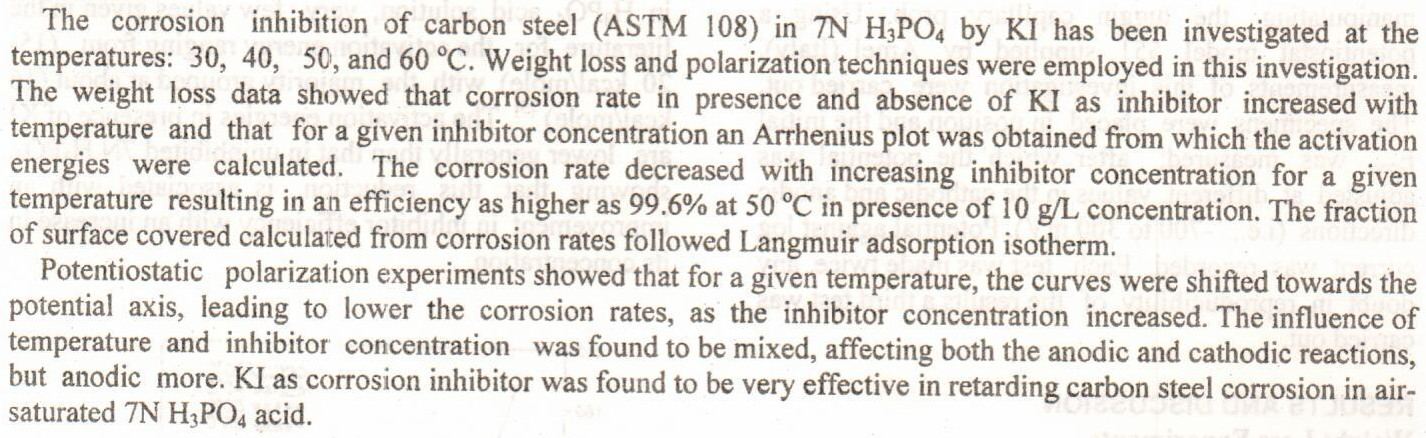
The Influence of Temperature on Corrosion Inhibition of Carbon Steel in Air-Saturated 7NH3PO4 by Potassium Iodide

Stone Matrix Asphalt (SMA) is a gap-graded asphalt concrete hot blend combining high-quality coarse aggregate with a rich asphalt cement content. This blend generates a stable paving combination with a powerful stone-on-stone skeleton that offers excellent durability and routing strength. The objectives of this work are: Studying the durability performance of stone matrix asphalt (SMA) mixture in terms of moisture damage and temperature susceptibility and Discovering the effect of stabilized additive (Fly Ash ) on the performance of stone matrix asphalt (SMA) mixture. In this investigation, the durability of stone matrix asphalt concrete was assessed in terms of temperature susceptibility, resistance to moisture damage, and sensitivity t
... Show More (2)
(2)

In this research, non-thermal plasma system of argon gas is designed to work at normal atmospheric pressure and suitable for work in medical and biotechnological applications. This technique is applied in the treatment of the Staphylococcus epidermidis bacteria and show the role of the flow rate of Argon gas on the killing rate of bacteria, and it obtained a 100 % killing rate during the time of 5 minutes at the flow Argon gas of 5 liters/ min.
(1)
The development of the perforated fin had proposed in many studies to enhance the heat transfer from electronic pieces. This paper presents a novel derivative method to find the temperature distribution of the new design (inclined perforated) of the pin fin. Perforated with rectangular section and different angles of inclination was considered. Signum Function is used for modeling the variable heat transfer area. Set of parameters to handle the conduction and convection area were calculated. Degenerate Hypergeometric Equation (DHE) was used for modeling the Complex energy differential equation and then solved by Kummer’s series. In the validation process, Ansys 16.0-Steady State Thermal was used. Two geometric models were consider
... Show More (3)
(2)
(3)
(2)

Heavy metal consider as major environmental pollutants. Many of industrial wastewater effluents contain a wide range of these heavy metals. The adsorption of Cd2+ and Pb2+ metal ions from aqueous solution by activated carbon was studied. The results showed that maximum adsorption capacity occurred at 486.9×10⁻³ mg/kg for Pb2+ ion and 548.8×10⁻³ mg/kg for Cd2+ ion. The adsorption in a mixture of the metal ions had a balancing effect on the adsorption capacity of the activated carbon. The adsorption capacity of each metal ion was affected by the presence of other metal ions rather than its presence individually. The study showed the presence of other heavy metals attribute to the reduction in the activated carbon capacity, and the adsorp
... Show MoreThe presence of antibiotic residues such as ciprofloxacin (CIPR) in an aqueous environment is dangerous when their concentrations exceed the allowable. Therefore, eliminating these residues from the wastewater becomes an essential issue to prevent their harm. In this work, the potential of efficient adsorption of ciprofloxacin antibiotics was studied using eco-friendly ZSM-5 nanocrystals‑carbon composite (NZC). An inexpensive effective natural binder made of the sucrose-citric acid mixture was used for preparing NZC. The characterization methods revealed the successful preparation of NZC with a favorable surface area of 103.739 m2/g, and unique morphology and functional groups. Investigating the ability of NZC for adsorbing CIPR antibioti
... Show More
(61)
In this work the effect of annealing temperature on the structure and the electrical properties of Bi thin films was studied, the Bi films were deposited on glass substrates at room temperature by thermal evaporation technique with thickness (0.4 µm) and rate of deposition equal to 6.66Å/sec, all samples are annealed in a vacuum for one hour. The X-ray diffraction analysis shows that the prepared samples are polycrystalline and it exhibits hexagonal structure. The electrical properties of these films were studied with different annealing temperatures, the d.c conductivity for films decreases from 16.42 ? 10-2 at 343K to 10.11?10-2 (?.cm)-1 at 363K. The electrical activation energies Ea1 and Ea2 increase from 0.031 to 0.049eV and
... Show More
(1)
Helicobacter pylori (HP) colonizes the gastric mucosa and causes gastric and extra-gastric disorders. Several liver diseases, such as Non-alcoholic fatty liver disease, seem to be caused by the gastrointestinal tract, which is primarily determined by the presence of bacteria like Helicobacter pylori. The study aims to evaluate the relationship between Helicobacter pylori infection and liver diseases by measuring liver enzymes, inflammatory markers, and hematological parameters among patients with gastritis and without Helicobacter pylori infection. A total of 1,325 patients who had gastritis diagnosed by gastroscopy were included in our study. They were divided into the HP– group (340 women, 323 men) and the HP+ group (330 women,
... Show More
The aim of the research is to investigate the effect of cold plasma on the bacteria grown on texture of sesame paste in its normal particle and nano particle size. Starting by using the image segmentation process depending on the threshold method, it is used to get rid of the reflection of the glass slides on which the sesame samples are placed. The classification process implemented to separate the sesame paste texture from normal and abnormal texture. The abnormal texture appears when the bacteria has been grown on the sesame paste after being left for two days in the air, unsupervised k-mean classification process used to classify the infected region, the normal region and the treated region. The bacteria treated with cold plasma, t
... Show More
(13)
(7)

ABSTRACT Background: Bracket rebonding is a common problem in orthodontics which may result in many drawbacks. The aims of this study were to evaluate the effects of application of two enamel protective agents “Icon†and “ProSeal†on shear bond strength before and after rebonding of stainless steel orthodontic brackets using conventional orthodontic adhesive and to assess the site of bond failure. Materials and methods: Fifty sound extracted human upper first premolar teeth were selected and randomly divided into two equal groups; the first time bonding and the rebonding groups (n=30). Each group was subdivided into control, Icon and ProSeal subgroups. The enamel protective agents were applied after etching (precondi
... Show More
(5)
(2)