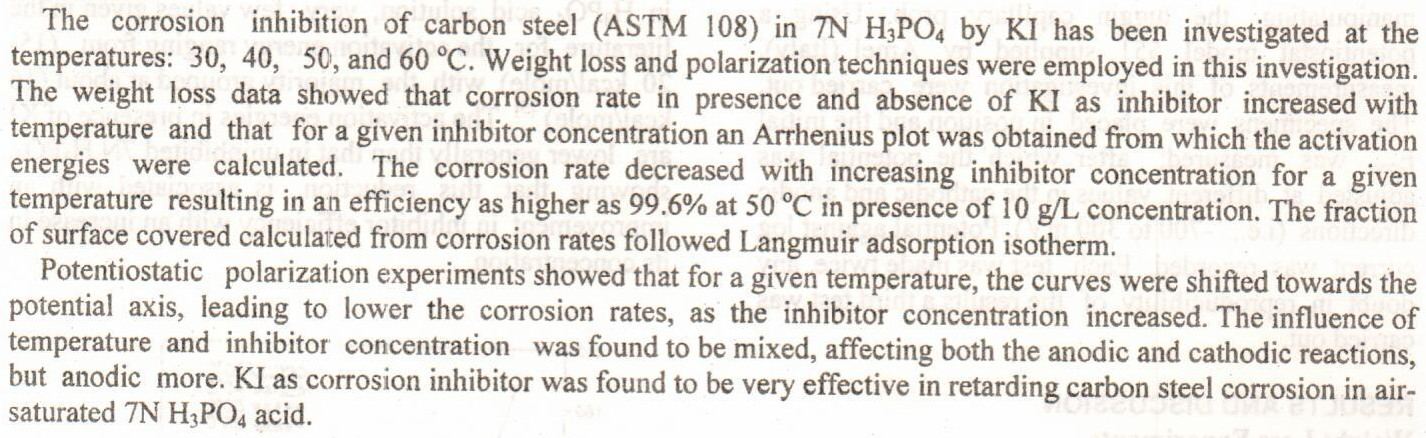
The Influence of Temperature on Corrosion Inhibition of Carbon Steel in Air-Saturated 7NH3PO4 by Potassium Iodide

Iraqi calcium bentonite was activated via acidification to study its structural and electrical properties. The elemental analysis of treated bentonite was determined by using X-ray fluorescence while the unit crystal structure was studied through X-ray diffraction showing disappearance of some fundamental reflections due to the treatment processes. The surface morphology, on the other hand, was studied thoroughly by Scanning Electron microscopy SEM and Atomic Force Microscope AFM showing some fragments of montmorillonite sheets. Furthermore, the electrical properties of bentonite were studied including: The dielectric permittivity, conductivity, tangent loss factor, and impedance with range of frequency (0.1-1000 KHz) at different temperatu
... Show MoreA new 4-thiazolidinone, substitutedbenzylidene-thiazolidinone and tetrazole were synthesized from thiosemicarbazone and hydrazone. The thiosemicarbazone was prepared by the reaction of thiosemicarbazide with aldehyde derivative from L-ascorbic acid in absolute ethanol using glacial acetic acid as a catalyst. 1, 3-thiazolidin-4-ones were synthesized from the condensation of thiosemicarbazones with chloroacetic acid in presence of anhydrous sodium acetate. A 1, 3- thiazolidine-4-one was reaction with several 4-substitutedaldehydes to produce new derivatives with a double bond at the position-5 of the 4-thiazolidinone ring. While the tetrazole compounds were synthesized by 1, 3-cycloaddition reaction of sodium azide and hydrazone compounds in
... Show MoreCoupling reaction of 4-amino antipyrene with 4-amino benzoic acid gave bidentate azo ligand. The prepared ligand was identified by Microelemental Analysis, 1HNMR, FT-IR and UV-Vis spectroscopic techniques. Treatment of the prepared ligand with the following metal ions (CoII, NiII, CuII and ZnII) in aqueous ethanol with a 1:2 M:L ratio and at optimum pH, yielded a series of neutral complexes of the general formula [M(L)2]Cl2 . The prepared complexes were characterized using flame atomic absorption, (C.H.N) Analysis, FT-IR and UV-Vis spectroscopic methods as well as magnetic susceptibility and conductivity measurements. Chloride ion content was also evaluated by (Mohr method). The nature of the complexes formed were studied following the mol
... Show MoreThe esterification of oleic acid with 2-ethylhexanol in presence of sulfuric acid as homogeneous catalyst was investigated in this work to produce 2-ethylhexyl oleate (biodiesel) by using semi batch reactive distillation. The effect of reaction temperature (100 to 130°C), 2-ethylhexanol:oleic acid molar ratio (1:1 to 1:3) and catalysts concentration (0.2 to 1wt%) were studied. Higher conversion of 97% was achieved with operating conditions of reaction temperature of 130°C, molar ratio of free fatty acid to alcohol of 1:2 and catalyst concentration of 1wt%. A simulation was adopted from basic principles of the reactive distillation using MATLAB to describe the process. Good agreement was achieved.
Massive multiple-input multiple-output (massive-MIMO) is considered as the key technology to meet the huge demands of data rates in the future wireless communications networks. However, for massive-MIMO systems to realize their maximum potential gain, sufficiently accurate downlink (DL) channel state information (CSI) with low overhead to meet the short coherence time (CT) is required. Therefore, this article aims to overcome the technical challenge of DL CSI estimation in a frequency-division-duplex (FDD) massive-MIMO with short CT considering five different physical correlation models. To this end, the statistical structure of the massive-MIMO channel, which is captured by the physical correlation is exploited to find sufficiently
... Show More (5)
(5)
 (5)
(5)



Four new complexes of Pd(II), Pt(II) and Pt(IV) with DMSO solution of the ligand 8-[(4-nitrophenyl)azo]guanine (L) have been synthesized. Reaction of the ligand with Pd(II) at different pH gave two new complexes, at pH=8, a complex of the formula [Pd(L)2]Cl2.DMSO (1) was formed, while at pH=4.5,the complex[Pd(L)3]Cl2.DMSO (2) was obtained. Meanwhile, the reaction of the ligand with Pt(II) and Pt(IV) revealed new complexes with the formulas[Pt(L)2]Cl2.DMSO (3)and [Pt(L)3]Cl4.DMSO (4) at pH 7.5 and 6 respectively.
All the preparations were performed after fixing the optimum pH and concentration. The effect of time on the stability of these complexes was checked. The stoichiometry of the complexes was determined by the mole ratio and Job
A series of coumarin derivatives linked to amino acid ester side chains were synthesized and evaluated of their antibacterial and antifungal activity. The coumarin derivatives was alkylated by the ethyl bromoacetate and then using potassium carbonate to get alkylated hymecromone. Conventional solution method for amide bond formation was used as a coupling method between the carboxy-protected amino acids with acetic acid side chain of coumarin derivatives. The DCC/ HOBt coupling reagents were used for peptide bond formation. The proposed analogues were successfully synthesized and their structural formulas were consistent with the proposed struct
... Show More
This paper concerns is the preparation and characterization of a bidentate ligand [4-(5,5- dimethyl-3-oxocyclohex-1-enylamino)-N-(5-methylisoxazol-3-yl) benzene sulfonamide]. The ligand was prepared from fusing of sulfamethoxazole and dimedone at (140) ºC for half hour. The complex was prepared by refluxing the ligand with a bivalent cobalt ion using ethanol as a solvent. The prepared ligand and complex were identified using Spectroscopic methods. The proposed tetrahedral geometry around the metal ions studied were concluded from these measurements. Both molar ratio and continuous variation method were studied to determine metal to ligand ratio (M:L). The M to L ratio was found to be (1:1). The adsorption of cobalt complex was carried out
... Show MoreThe present study explores the solar-induced photocatalytic degradation of reactive red (RR) and reactive turquoise (RT) dyes in a single system using TiO2 immobilized in xanthan gum (TiO2/XG), synthesized using the sol–gel dip-coating technique for direct precipitation. SEM-EDX, XRD, FTIR, and UV–Vis were used to assess the characteristics of the resulting catalyst. Moreover, the effects of different operating parameters, specifically pH, dye concentration, TiO2/XG concentration, H2O2 concentration, and contact time, were also investigated in a batch photocatalytic reactor. The immobilized TiO2/XG catalyst showed a slight adsorption degradation efficiency and then improved the RR and RT dye degradation activity (92.5 and 90.8%
... Show More
(22)
(19)
(15)
(8)