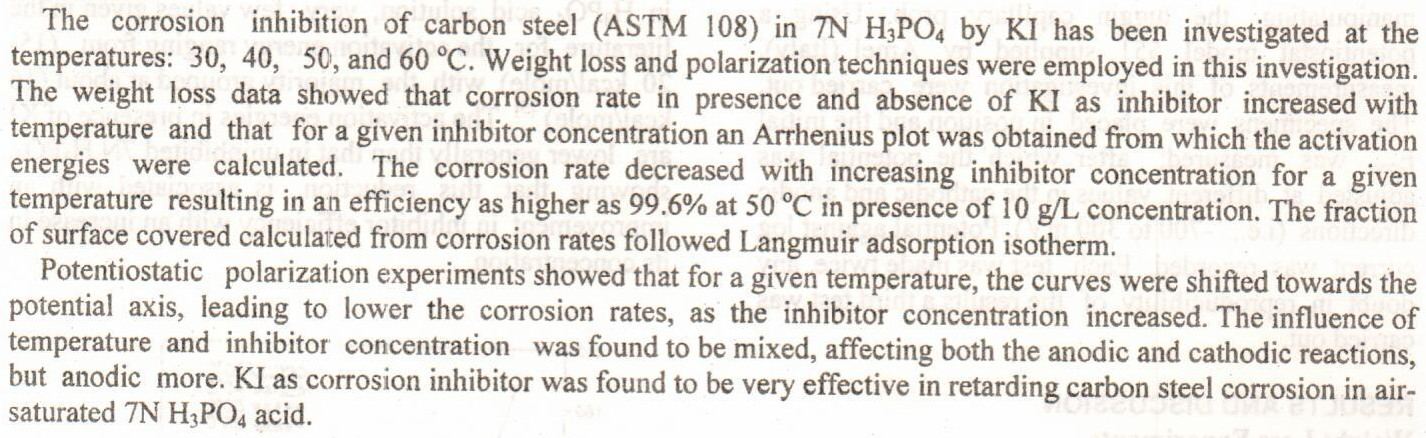
The Influence of Temperature on Corrosion Inhibition of Carbon Steel in Air-Saturated 7NH3PO4 by Potassium Iodide

The coefficient of charge transfer at heterogeneous devices of Au metal with a well-known dyeis investigations using quantum model.Four different solvent are used to estimation the effective transition energy. The potential barrier at interface of Au and dye has been determined using effective transition energy and difference between the Fermi energy of Au metal and ionization energy of dye. A possible transfer mechanism cross the potential barrier dyeand coupling strength interaction between the electronic levels in systems of Au and is discussed.Differentdata of effective transition energy and potential barrier calculations suggest that solvent is more suitable to binds Au with dye.
 (1)
(1)
 (1)
(1)


Mn2+ and Ce3+ Doped ZnS nanocrystals were prepared by a simple microwave irradiation method under mild condition. The starting materials for the synthesis of Mn2+ and Ce3+ Doped ZnS P nanocrystals were zinc acetate as zinc source, thioacetamide as a sulfur source, manganese chloride and Cerium chloride as manganese and cerium sources respectively (R & M Chemical) and ethylene glycol as a solvent. All chemicals were analytical grade products and used without further purification. The nanocrystals of Mn2+ and Ce3+ Doped ZnS P with cubic structure were characterized by X-ray powder diffraction (XRD), the morphology of the film is seen by field effect scanning electron microscopy (FESEM). The composition of the samples is analyzed by EDS. The s
... Show More
(4)
(4)
 (28)
(25)
(28)
(25)
In this study, the nanocrystal-ZnS-loaded graphene was synthesized by a facile coprecipitation route. The effect of graphene on the characterization of Zinc Sulphide (ZnS) was investigated. The X-ray Diffraction (XRD) results reveal that ZnS has cubic system while hexagonal structure which is observed by loading graphene during the preparation of ZnS. Energy Dispersive X-ray Spectroscopy (EDS) analysis proved the presence of all expected elements in the prepared materials. Nanosize of fabricated materials has been measured using Scanning Electron Microscopy (SEM) technique. This study also found that the graphene plays a critical role in lowering the optical energy gap of ZnS nanoparticles from 4 eV to 3.2 eV. The characterization of detec
... Show More
(2)
(2)
(1)
Criticism, as an evaluative criterion, is a significant speech act for English language learners to improve their speech and actions in their academic life. Yet, it is realized differently across diverse cultures. Few studies have shown that the linguistics forms of one language are different from those available in another language. Hence, this study aims to investigate the cross-cultural similarities and differences between 60 Iraqi and Malay university learners in the use of criticism strategies. The data are collected using a Discourse Completion Test (DCT) and a Focus Group Interview (FGI). The data are coded based on Nguyen’s (2005) coding scheme of criticism in terms of the realization strategies. Qualitative
... Show More
(1)
This paper introduces a Laplace-based modeling approach for the study of transient converter-grid interactions. The proposed approach is based on the development of two-port admittance models of converters and other components, combined with the use of numerical Laplace transforms. The application of a frequency domain method is aimed at the accurate and straightforward computation of transient system responses while preserving the wideband frequency characteristics of power components, such as those due to the use of high frequency semiconductive switches, electromagnetic interaction between inductive and capacitive components, as well as wave propagation and frequency dependence in transmission systems.
(5)
(4)
Several new derivatives of 1, 2, 4-triazoles linked to phthalimide moiety were synthesized through following multisteps. The first step involved preparation of 2, 2-diphthalimidyl ethanoic acid [2] via reaction of two moles of phthalimide with dichloroacetic acid. Treatment of the resulted imide with ethanol in the second step afforded 2, 2-diphthalimidyl ester [3] which inturn was introduced in reaction with hydrazine hydrate in the third step, producing the corresponding hydrazide derivative [4]. The synthesized hydazide was introduced in different synthetic paths including treatment with carbon disulfide in alkaline solution then with hydrazine hydrate to afford the new 1, 2, 4-triazole [10]. Reaction of compound [10] with different alde
... Show MoreThe calculation of the oil density is more complex due to a wide range of pressuresand temperatures, which are always determined by specific conditions, pressure andtemperature. Therefore, the calculations that depend on oil components are moreaccurate and easier in finding such kind of requirements. The analyses of twenty liveoil samples are utilized. The three parameters Peng Robinson equation of state istuned to get match between measured and calculated oil viscosity. The Lohrenz-Bray-Clark (LBC) viscosity calculation technique is adopted to calculate the viscosity of oilfrom the given composition, pressure and temperature for 20 samples. The tunedequation of state is used to generate oil viscosity values for a range of temperatu
... Show More
(1)