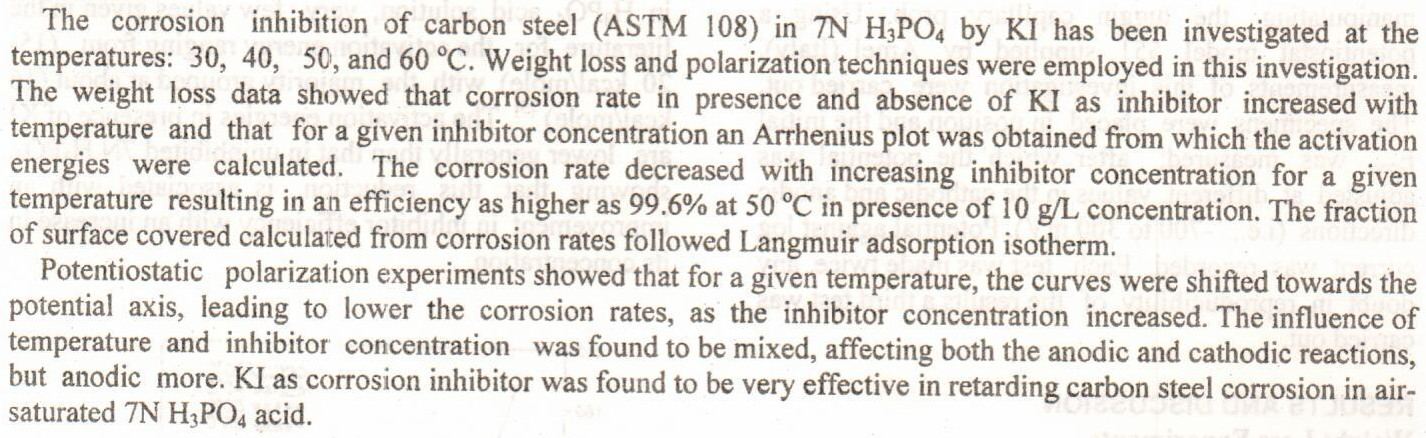
The Influence of Temperature on Corrosion Inhibition of Carbon Steel in Air-Saturated 7NH3PO4 by Potassium Iodide

This work describes, selenium (Se) films were deposited on clean glass substrates by dc planar magnetron sputtering technique.The dependence of sputtering deposition rate of Se film deposited on pressure and DC power has been studied. The optimum argon pressure has range (4x10⁻¹ -8x10⁻² )mbar. The optical properties such as absorption coefficient (α) was determined using the absorbance and transmission measurement from UnicoUV-2102 PC spectrophotometer, at normal incidence of light in the wavelength range of 200-850 nm. And also we calculated optical constants(refractive index (n), dielectric constant (εi,r), and Extinction coefficient (κ) for selenium films.
In this study, the response and behavior of machine foundations resting on dry and saturated sand was investigated experimentally. A physical model was manufactured to simulate steady state harmonic load applied on a footing resting on sandy soil at different operating frequencies. Total of (84) physical models were performed. The parameters that were taken into consideration include loading frequency, size of footing and different soil conditions. The footing parameters are related to the size of the rectangular footing and depth of embedment. Two sizes of rectangular steel model footing were used. The footings were tested by changing all parameters at the surface and at 50 mm depth below model surface. Meanwhile, the investigated paramete
... Show More (21)
(21)

 (2)
(2)
(2)
(2)
 (28)
(23)
(28)
(23)

Three cohesionless free flowing materials of different density were mixed in an air fluidized bed to study the mixing process by calculating performance of mixing index according to Rose equation (1959) and to study the effect of four variables (air velocity, mixing time, particle size of trace component and concentration of trace component) on the mixing index and as well as on mixing performance. It was found that mixing index increases with increasing the air velocity, mixing time and concentration of trace component until the optimum value. Mixing index depends on the magnitude of difference in particle size The first set of experiments (salt then sand then cast iron) give higher mixing index and better performance of mixing than the
... Show Morea porentioncsisteve has been carried out of the corrosion behavior of inconel(600) in chloride ions (Cl) over the tempreatures 293 over the temperatures 308K in both the dcacrated and the alloy
Reaxys Chemistry database information SciVal Topics Metrics Abstract A novel CoO–ZnO nanocomposite was synthesized by the photo irradiation method using a solution of cobalt and zinc complexes and used as a coating applied by electrophoretic deposition (EPD) for corrosion protection of stainless steel (SS) in saline solution. The samples were characterized using powder XRD, scanning electron microscopy (SEM) and electrochemical polarization. It was also found that the coating was still stable after conducting the corrosion test: it contained no cracks and CoO–ZnO nanocomposites clearly appeared on the surface. SEM showed that the significant surface cracking disappeared. XRD confirmed that CoO–ZnO nanocomposites comprised CoO and Zn
... Show More
(21)
(6)
In the present work, pulsed laser deposition (PLD) technique was applied to a pellet of Chromium Oxide (99.999% pure) with 2.5 cm diameter and 3 mm thickness at a pressure of 5 Tons using a Hydraulic piston. The films were deposited using Nd: YAG laser λ= (4664) nm at 600 mJ and 400 number of shot on a glass substrate, The thickness of the film was (107 nm). Structural and morphological analysis showed that the films started to crystallize at annealing temperature greater than 400 oC. Absorbance and transmittance spectra were recorded in the wavelength range (300-
4400) nm before and after annealing. The effects of annealing temperature on absorption coefficient, refractive index, extinction coefficient, real and imaginary parts of d
(3)