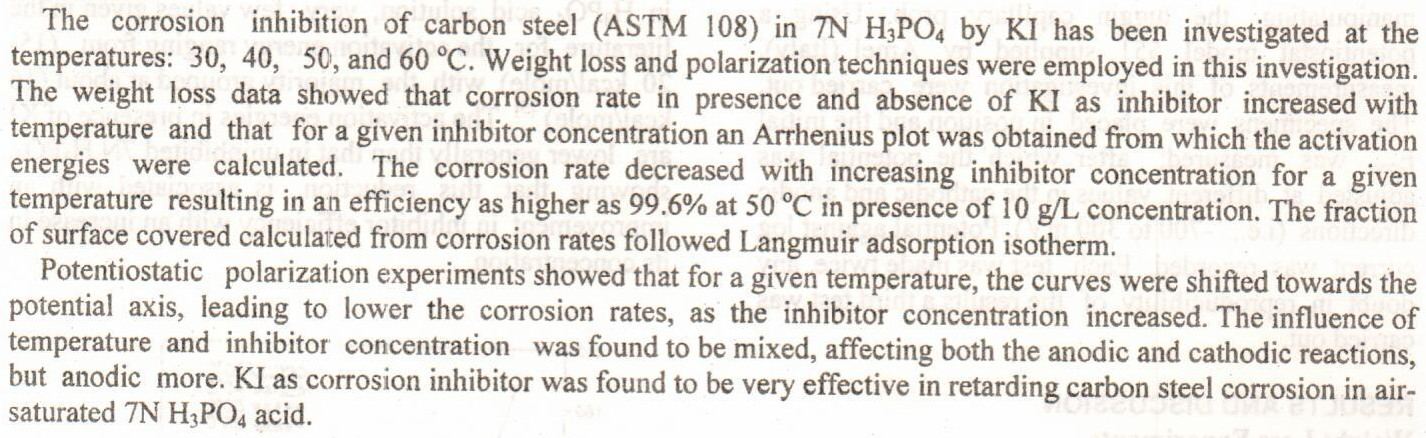
The Influence of Temperature on Corrosion Inhibition of Carbon Steel in Air-Saturated 7NH3PO4 by Potassium Iodide

The aim of the present work, was measuring of uranium concentrations in 25 soil samples from five locations of Al-Kut city. The samples taken from different depths ranged from soil surface to 60cm step 15 cm, for this measurement of uranium concentrations .The most widely used technique SSNTDs was chosen to be the measurement technique. Results showed that the higher concentrations were in Hai Al- Kafaat which recorded 1.49 ± 0.054 ppm . The uranium content in soil samples were less than permissible limit of UNSCEAR(11.7ppm).
 (1)
(1)

It is no secret to anyone that studying and investigating books of jurisprudence, despite their suffering, is a pleasure that cannot be compared to pleasure, and it has benefits and importance that cannot be limited and summed up, and it has great fruits that researchers and students of knowledge reap, as well as enriching libraries with jurisprudential material, after dusting them and taking them out to the light of libraries to be seen. Researchers and scholars, generation after generation, so that this nation can benefit from this pioneering intellectual and scientific product that was written for us by our first ancestors of working scholars who enriched human civilization with this scientific material, which has become a beacon guid
... Show MoreIn this study, oxidative desulfurization of dibenzothiophene (DBT) with H2O2 as an oxidant was studied, whereas the catalyst used was zirconium oxide supported on Activated carbon (AC). Zirconium oxide (ZrO2) was impregnated over prepared activated carbon (AC) and characterized by various techniques such as XRD, FTIR, BET, SEM, and EDX. This composite was used as a heterogeneous catalyst for oxidation desulfurization of simulated oil. The results of this study showed that ZrO2/AC composite exhibited significant catalytic activity and stability, effectively lowering sulfur content under mild conditions. Factors such as reaction temperature (30, 40, 50, 60°C), time (5, 10, 15,20,30,60, 80 100 min), catalyst dose (0.3, 0.5,
... Show More
The solution casting method was used to prepare a polyvinylpyrrolidone (PVP)/Multi-walled carbon nanotubes (MWCNTs) nanocomposite with Graphene (Gr). Field Effect Scanning Electron Microscope (FESEM) and Fourier Transformer Infrared (FTIR) were used to characterize the surface morphology and optical properties of samples. FESEM images revealed a uniform distribution of graphene within the PVP-MWCNT nanocomposite. The FTIR spectra confirmed the nanocomposite information is successful with apperaring the presence of primary distinct peaks belonging to vibration groups that describe the prepared samples.. Furthermore, found that the DC electrical conductivity of the prepared nanocomposites increases with increasing MWCNT concentratio
... Show More (2)
(3)
(2)
(3)

This research study the effect of surface modification and copper (Cu) plating carbon fiber (CF) surface on the thermal stability and wettability of carbon fiber (CF)/epoxy (EP) composites. The TGA result indicates that the thermal-stability of carbon fiber may be enhanced after Cu coating CF. TGA curve showed that the treatment temperature was enhanced thermal stability of Ep/CF, this is due to the oxidation during heating. The Cu plating increased the thermal conductivity, this increase might be due to reduce in contact resistance at the interface due to chemical modification and copper plating and tunneling resistance.
The increase of surface polarity after coating cause decreas
... Show More
(9)
In this work, polyvinylpyrrolidone (PVP), Multi-walled carbon nanotubes (MWCNTs) nanocomposite was prepared and hybrid with Graphene (Gr) by casting method. The morphological and optical properties were investigated. Fourier Transformer-Infrared (FT-IR) indicates the presence of primary distinctive peaks belonging to vibration groups that describe the prepared samples. Scanning Electron Microscopy (SEM) images showed a uniform dispersion of graphene within the PVP-MWCNT nanocomposite. The results of the optical study show decrease in the energy gap with increasing MWCNT and graphene concentration. The absorption coefficient spectra indicate the presence of two absorption peaks at 282 and 287 nm attributed to the π-π* electronic tr
... Show More
(7)
(5)
The use of biopolymer material Chitosan impregnated granular activated carbon CHGAC as adsorbent in the removal of lead ions pb.2+ from aqueous solution was studied using batch adsorption mode. The prepared CHGAC was characterized by Scanning Electronic Microscopy (SEM) and atomic-absorption pectrophotometer. The adsorption of lead ions onto Chitosan-impregnated granular activated carbon was examined as a function of adsorbent weight, pH and
contact time in Batch system. Langmuir and Freundlich models were employed to analyze the resulting experimental data demonstrated that better fitted by Langmuir isotherm model than Freundlich model, with good correlation coefficient. The maximum adsorption capacity calculated f
This study involves the design of 24 mixtures of fiber reinforced magnetic reactive powder concrete containing nano silica. Tap water was used for 12 of these mixtures, while magnetic water was used for the others. The nano silica (NS) with ratios (1, 1.5, 2, 2.5 and 3) % by weight of cement, were used for all the mixtures. The results have shown that the mixture containing 2.5% NS gives the highest compressive strength at age 7 days. Many different other tests were carried out, the results have shown that the carbon fiber reinforced magnetic reactive powder concrete containing 2.5% NS (CFRMRPCCNS) had higher compressive strength, modulus of rupture, splitting tension, str
... Show MoreThis research is concerned to investigate the behavior of reinforced concrete (RC) deep beams strengthened with carbon fiber reinforced polymer (CFRP) strips. The experimental part of this research is carried out by testing seven RC deep beams having the same dimensions and steel reinforcement which have been divided into two groups according to the strengthening schemes. Group one was consisted of three deep beams strengthened with vertical U-wrapped CFRP strips. While, Group two was consisted of three deep beams strengthened with inclined CFRP strips oriented by 45o with the longitudinal axis of the beam. The remaining beam is kept unstrengthening as a reference beam. For each group, the variable considered
... Show More
(25)
(13)