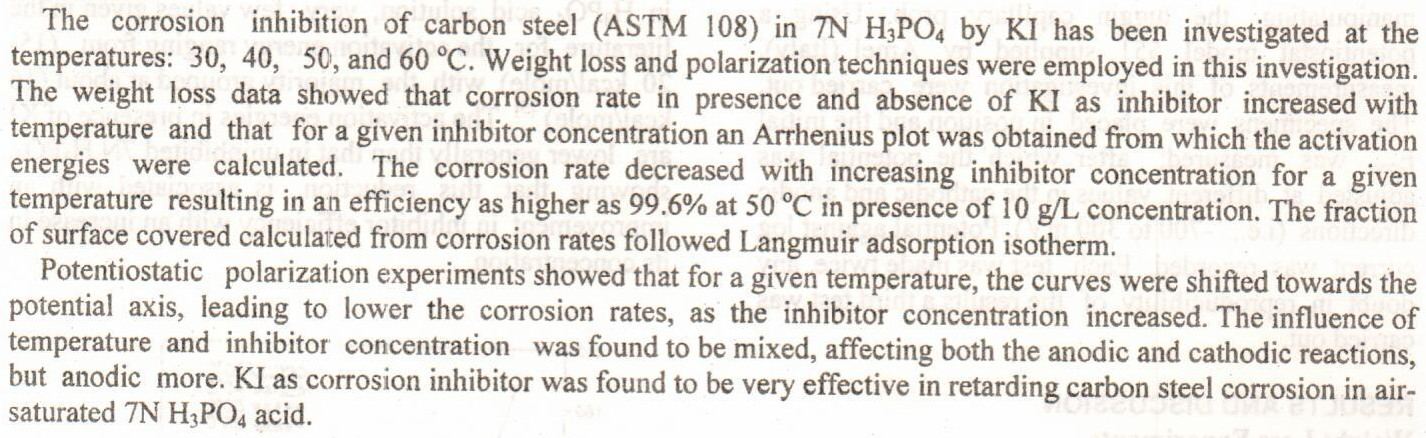
The Influence of Temperature on Corrosion Inhibition of Carbon Steel in Air-Saturated 7NH3PO4 by Potassium Iodide

In this study, the relationship between the bare soil temperature with respect to its salinity is presented, the bare soil feature is considered only by eliminating all other land features by classifying the site location by using the support vector machine algorithm, in the same time the salinity index that calculated from the spectral response from the satellite bands is calibrated using empirical salinity value calculated from field soil samples. A 2D probability density function is used to analyze the relationship between the temperature rising from the minimum temperature (from the sunrise time) due to the solar radiation duration tell the time of the satellite capturing the scene image and the calibrated salinity index is presented. T
... Show More (6)
(6)
 (4)
(4)



Rutting is a predominant distress in asphalt pavements, particularly in hot climatic regions. This study systematically investigated the high-temperature performance of hot mix asphalt modified with five nanomaterials, namely, nano-silica (NS), nano-alumina (NA), nano-titanium (NT), nano-zinc (NZ), and carbon nanotubes (CNTs), under consistent laboratory conditions. Modification dosages were selected up to 10% for NS, NA, and NT, and up to 5% for NZ and CNTs. The experimental methodology comprised the following: (i) binder rheological characterization through rotational viscosity, G*/sinδ, and multiple stress creep recovery (MSCR) to quantify rutting susceptibility; (ii) chemical and microstructural assessments using Fourier transf
... Show More
(3)
(3)
Experimental research was carried out to investigate the performance of CFRP wrapping jackets used for retrofitting twelve square reinforced concrete (CR) column specimens damaged by exposure to fire flame, at different temperatures of 300, 500 and 700ºC, except for two specimens that were not burned. The specimens were then loaded axially till failure after gradual or sudden cooling. The specimens were divided into two groups containing two main reinforcement ratios, ρ= 0.0314 and ρ= 0.0542. This was followed by the retrofitting procedure that included wrapping all the specimens with two layers of CFRP fabric sheets. The test results of the retrofitted specimens showed that the fire damaged RC
... Show MoreAbstract
The fiber Bragg grating (FBG) technology has been rapidly applied in the sensing technology field. In this work, uniform FBG was used as pressure sensor based on measuring related Bragg wavelength shift. The pressure was applied directly by air compressor to the sensor and the pressure was ranged from 1 to 6 bar.
This sensor also was affected by the external temperature so as a result it could be used as a temperature sensor. This sensor could be used to monitor the pressure of dams. It has been shown from the result that the sensor is very sensitive to the pressure and the sensitivity was (67 pm\bar) and is very sensitive to temperature and the sensitivity was (10p
... Show More
(73)
(58)
In Iraq most of the small buildings deployed a conventional air conditioning technology which typically uses electrically driven compressor systems which exhibits several clear disadvantages such as high energy consumption, high electricity at peak loads. In this work a thermal performance of air conditioning system combined with a solar collector is investigated theoretically. The hybrid air conditioner consists of a semi hermetic compressor, water cooled shell and tube condenser, thermal expansion valve and coil with tank evaporator. The theoretical analysis included a simulation for the solar assisted air-conditioning system using EES software to analyze the effect of different parameters on the power consumption of c
... Show MoreBackground: evaluate the effects of three different intracoronal bleaching agents on the shear bond strengths (SBS) and failure site of stainless steel and monocrystalline (sapphire) orthodontic brackets bonded to endodontically treated teeth using light cured orthodontic adhesive in vitro. Materials and methods: Eighty extracted sound human upper first premolars were selected, endondontically treated and randomly divided equally (according to the type of the brackets used) into two main groups (n = 40 per group). Each main group were subdivided (according to the bleaching agent used) into four subgroups 10 teeth each; as following : control (un bleached) group, hydrogen peroxide group (Hp) 35%, carbamide peroxide group (CP) 37% group and s
... Show More
(10)
(10)
Biomass has been extensively investigated, because of its presence as clean energy source. Tars and particulates formation problems are still the major challenges in development especially in the implementation of gasification technologies into nowadays energy supply systems. Laser Induced Fluorescence spectroscopy (LIF) method is incorporated for determining aromatic and Polycyclic Aromatic Hydrocarbons (PAH) produced at high temperature gasification technology. The effect of tars deposition when the gases are cooled has been highly reduced by introducing a new concept of measurement cell. The samples of PAH components have been prepared with the standard constrictions of measured PAHs by using gas chromatograph (GC). OPO laser with tun
... Show More
(1)
(1)
The thermal method was used to produce silicoaluminophosphate (SAPO-11) with different amounts of carbon nanotubes (CNT). XRD, nitrogen adsorption-desorption, SEM, AFM, and FTIR were used to characterize the prepared catalyst. It was discovered that adding CNT increased the crystallinity of the synthesize SAPO-11 at all the temperatures which studied, wile the maximum surface area was 179.54 m2/g obtained at 190°C with 7.5 percent of CNT with a pore volume of 0.317 cm3/g ,and with nano-particles with average particle diameter of 24.8 nm, while the final molar composition of the prepared SAPO-11 was (Al2O3:0.93P2O5:0.414SiO2).
(1)