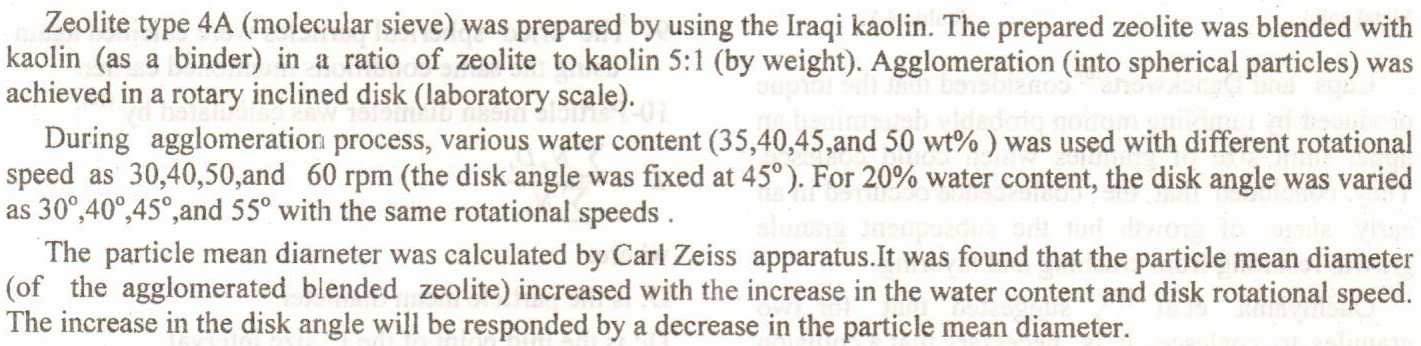
Preparation of Zeolite 4A and Studying the Operating Conditions of the Agglomeration in the Inclined Rotary Disk

 (43)
(43)
 (46)
(46)



To evaluate and improve the efficiency of photovoltaic solar modules connected with linear pipes for water supply, a three-dimensional numerical simulation is created and simulated via commercial software (Ansys-Fluent). The optimization utilizes the principles of the 1st and 2nd laws of thermodynamics by employing the Response Surface Method (RSM). Various design parameters, including the coolant inlet velocity, tube diameter, panel dimensions, and solar radiation intensity, are systematically varied to investigate their impacts on energetic and exergitic efficiencies and destroyed exergy. The relationship between the design parameters and the system responses is validated through the development of a predictive model. Both single and mult
... Show More
(27)
(31)
The purpose of this study is to underline the progression and development of research regarding oxygen-containing heterocycles as well as the contribution that some oxygen-containing heterocycles have made as anticancer medicines. A series of publications about the antitumor effects of derivatives of heterocyclic compounds containing an oxygen atom, such as furan, benzofuran, oxazole, benzoxazole, and oxadiazole, were evaluated, and their anticancer activities showed encouraging results when compared to those of established standard treatments.
(6)
(4)
Flexure members such as reinforced concrete (RC) simply supported beams subjected to two-point loading were analyzed numerically. The Extended Finite Element Method (XFEM) was employed for the treatment the non-smooth h behaviour such as discontinuities and singularities. This method is a powerful technique used for the analysis of the fracture process and crack propagation in concrete. Concrete is a heterogeneous material that consists of coarse aggregate, cement mortar and air voids distributed in the cement paste. Numerical modeling of concrete comprises a two-scale model, using mesoscale and macroscale numerical models. The effectiveness and validity of the Meso-Scale Approach (MSA) in modeling of the reinforced concrete beams w
... Show More
(3)
(2)
Spatial Intelligence is a mental ability to understand and solve real-world problems. These visual-spatial representations are fundamental in learning various "STEM" topics, like digital drawing, art presentations, creating graphical representations, 2D designs. Opportunity to interact with real and/or virtual objects. It is a good opportunity in applying new techniques such as the augmenter, which is able to clarify mathematical tables, concepts and generalizations greatly to the visualization, understanding and mastery of concepts mathematically. The purpose of the research is to investigate impact of using AR technology in developing spatial intelligence for secondary school students, Baghdad. The quasi-experimental design was us
... Show More
(22)
(16)
This paper features the modeling and design of a pole placement and output Feedback control technique for the Active Vibration Control (AVC) of a smart flexible cantilever beam for a Single Input Single Output (SISO) case. Measurements and actuation actions done by using patches of piezoelectric layer, it is bonded to the master structure as sensor/actuator at a certain position of the cantilever beam.
The smart structure is modeled based on the concept of piezoelectric theory, Bernoulli -Euler beam theory, using Finite Element Method (FEM) and the state space techniques. The number of modes is reduced using the controllability and observability grammians retaining the first three
dominant vibratory modes, and for the reduced syste
(5)
Whenever, the Internet of Things (IoT) applications and devices increased, the capability of the its access frequently stressed. That can lead a significant bottleneck problem for network performance in different layers of an end point to end point (P2P) communication route. So, an appropriate characteristic (i.e., classification) of the time changing traffic prediction has been used to solve this issue. Nevertheless, stills remain at great an open defy. Due to of the most of the presenting solutions depend on machine learning (ML) methods, that though give high calculation cost, where they are not taking into account the fine-accurately flow classification of the IoT devices is needed. Therefore, this paper presents a new model bas
... Show More
(10)
(8)
Flexible joint robot (FJR) manipulators can offer many attractive features over rigid manipulators, including light weight, safe operation, and high power efficiency. However, the tracking control of the FJR is challenging due to its inherent problems, such as underactuation, coupling, nonlinearities, uncertainties, and unknown external disturbances. In this article, a terminal sliding mode control (TSMC) is proposed for the FJR system to guarantee the finite-time convergence of the systems output, and to achieve the total robustness against the lumped disturbance and estimation error. By using two coordinate transformations, the FJR dynamics is turned into a canonical form. A cascaded finite-time sliding mode observer (CFTSMO) is construct
... Show More
(153)
(144)
Various speech enhancement Algorithms (SEA) have been developed in the last few decades. Each algorithm has its advantages and disadvantages because the speech signal is affected by environmental situations. Distortion of speech results in the loss of important features that make this signal challenging to understand. SEA aims to improve the intelligibility and quality of speech that different types of noise have degraded. In most applications, quality improvement is highly desirable as it can reduce listener fatigue, especially when the listener is exposed to high noise levels for extended periods (e.g., manufacturing). SEA reduces or suppresses the background noise to some degree, sometimes called noise suppression alg
... Show More
(5)
(17)
(11)