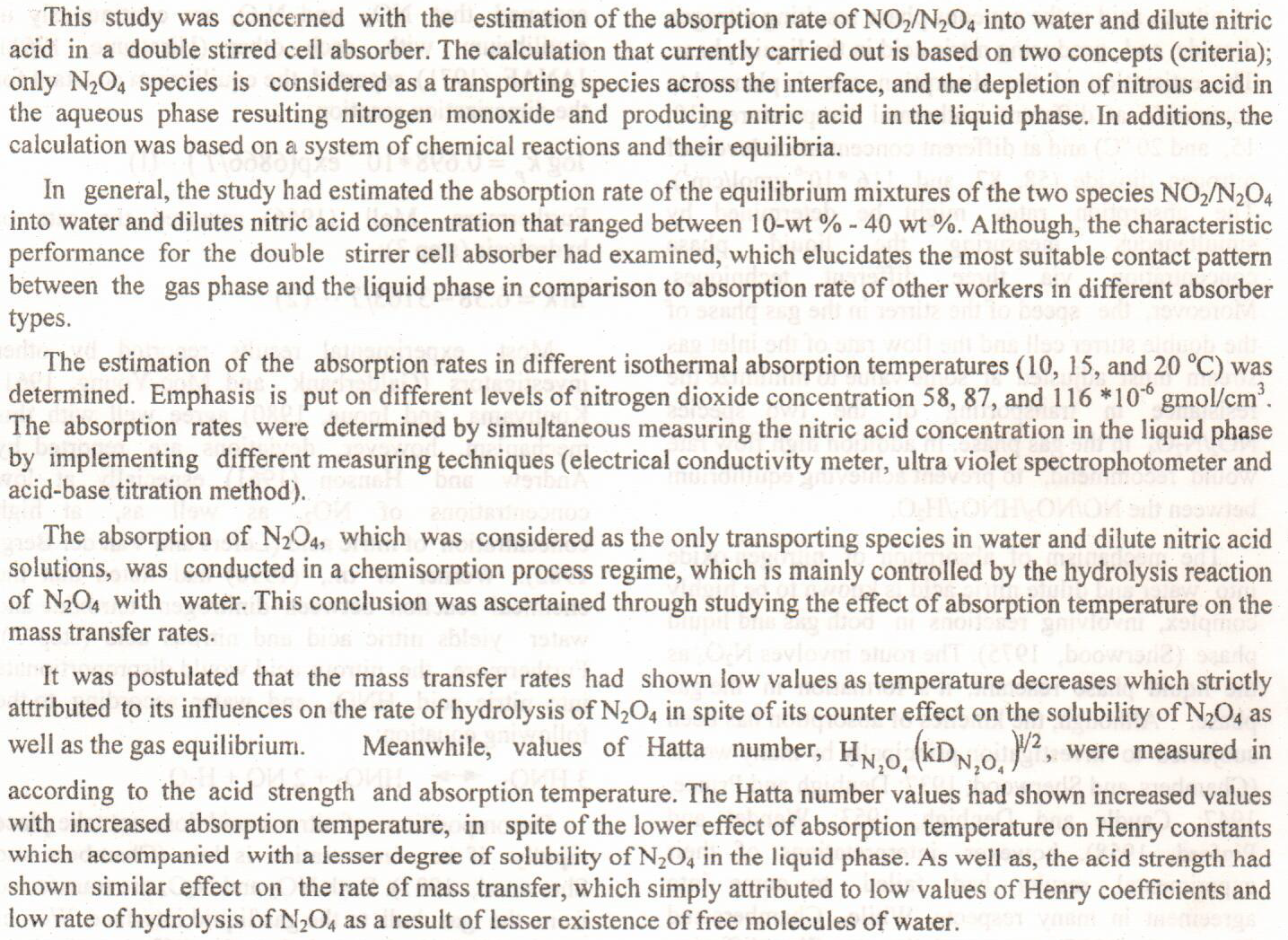
Adsorption of NO2/N2O4 into Water and Dilute Nitric Acid in a Double Stirrer Adsorber

Low conversion copolymerization of acrylamide AM (monomer-1) have been conducted with acrylic acid AA in dry benzene at 70°C , using Benzoyl peroxide BPO as initiator . The copolymer composition has been determined by elemental analysis. The monomer reactivity ratios have been calculated by the Kelen-Tudos and Finman-Ross graphical procedures. The derived reactivity ratios (r1, r2) are: (0.620, 0.996) for (AM / AA) systems , and found that the reactivity of the monomer AA is more than the monomer AM in the copolymerization of (AA/AM) system. The reactivity ratios values were used for microstructures calculation.
 (2)
(2)

Reacts compound C6H5PO2Cl2 with Secretary secondary R2NH at room temperature by Mulet 2:1 and using chloroform as a solvent in dry conditions to form composite 2HCl and the interaction of compound solution of sodium hydroxide and potassium by Mulet 3:1 salt was prepared
The corrosion behavior of bare and chemical conversion coated (through anodizing) aluminum ASA 606 I in stagnant chromic acid solutions . Solutions of 2, 6 & J O wt. % Cr03 at 45°C, have been investigated using polarization technique. The anodizing experiments were conducted under fixed conditions of 35 minute exposure time and 30 volt supplied voltage. The most important feature achieved was the great difference in behavior between the anodic polarization curves for bare and anodized aluminum in different concentrations of chromic acid solutions.
In this work, studying the effect of ethylenediamine as a corrosion inhibitor was investigated for carbon steel in aerated HCl solution in range of 0.1-1N under dynamic conditions, i.e., rotational velocity of 400–1200 rpm in the temperature range 35 – 65 ºC. Weight loss method was employed in absence and presence of the inhibitor as an adsorption type in concentration range 1000 – 5000 ppm using rotating cylinder specimens. The experimental results showed that corrosion rate in absence and presence of inhibitor is increased with increasing temperature, rotational velocity and concentration of acid. It is decreased with increasing inhibitor concentration for the whole range of temperature, rotational velocity and concentrati
... Show MoreThe subject of this research involves studying adsorption to remove hexavalent chromium Cr(VI) from aqueous solutions. Adsorption process on bentonite clay as adsorbent was used in the Cr(VI) concentration range (10-100) ppm at different temperatures (298, 303, 308 and 313)K, for different periods of time. The adsorption isotherms were obtained by obeying Langmuir and Freundlich adsorption isotherm with R2 (0.9921-0.9060) and (0.994-0.9998), respectively. The thermodynamic parameters were calculated by using the adsorption process at four different temperatures the values of ?H, ?G and ?S was [(+6.582 ? +6.547) kJ.mol-1, (-284.560 ? -343.070) kJ.mol-1 and (+0.977 ? +1.117) kJ.K-1.mol-1] respectively. This data indicates the spontaneous sorp
... Show More
(1)
Source, sedimentation, coagulation, flocculation, filter, and tank are parts of a water treatment plant. As a result, some issues threaten the process and affect the drinking water quality, which is required to provide clean drinking water according to special standards and international and local specifications, determined by laboratory results from physical, chemical, and biological tests. In order to keep the water safe for drinking, it is necessary to analyze the risks and assess the pollution that occurs in every part of the plant. The method is carried out in a common way, which is monitoring through laboratory tests, and it is among the standards of the global and local health regulators
Source, sedimentation, coagulation, flocculation, filter, and tank are parts of a water treatment plant. As a result, some issues threaten the process and affect the drinking water quality, which is required to provide clean drinking water according to special standards and international and local specifications, determined by laboratory results from physical, chemical, and biological tests. In order to keep the water safe for drinking, it is necessary to analyze the risks and assess the pollution that occurs in every part of the plant. The method is carried out in a common way, which is monitoring through laboratory tests, and it is among the standards of the global and local health regulators
This research paper aimed to quantitively characterize the pore structure of shale reservoirs. Six samples of Silurian shale from the Ahnet basin were selected for nitrogen adsorption-desorption analysis. Experimental findings showed that all the samples are mainly composed of mesopores with slit-like shaped pores, as well as the Barrett-Joyner-Halenda pore volume ranging from 0.014 to 0.046 cm3/ 100 g, where the lowest value has recorded in the AHTT-1 sample, whereas the highest one in AHTT-6, while the rest samples (AHTT-2, AHTT-3, AHTT-4, AHTT-5) have a similar average value of 0.03 cm3/ 100 g. Meanwhile, the surface area and pore size distribution were in the range of 3.8 to 11.1 m2 / g and 1.7 to 40 nm, respectively.
... Show More (2)
(1)
(2)
(1)
