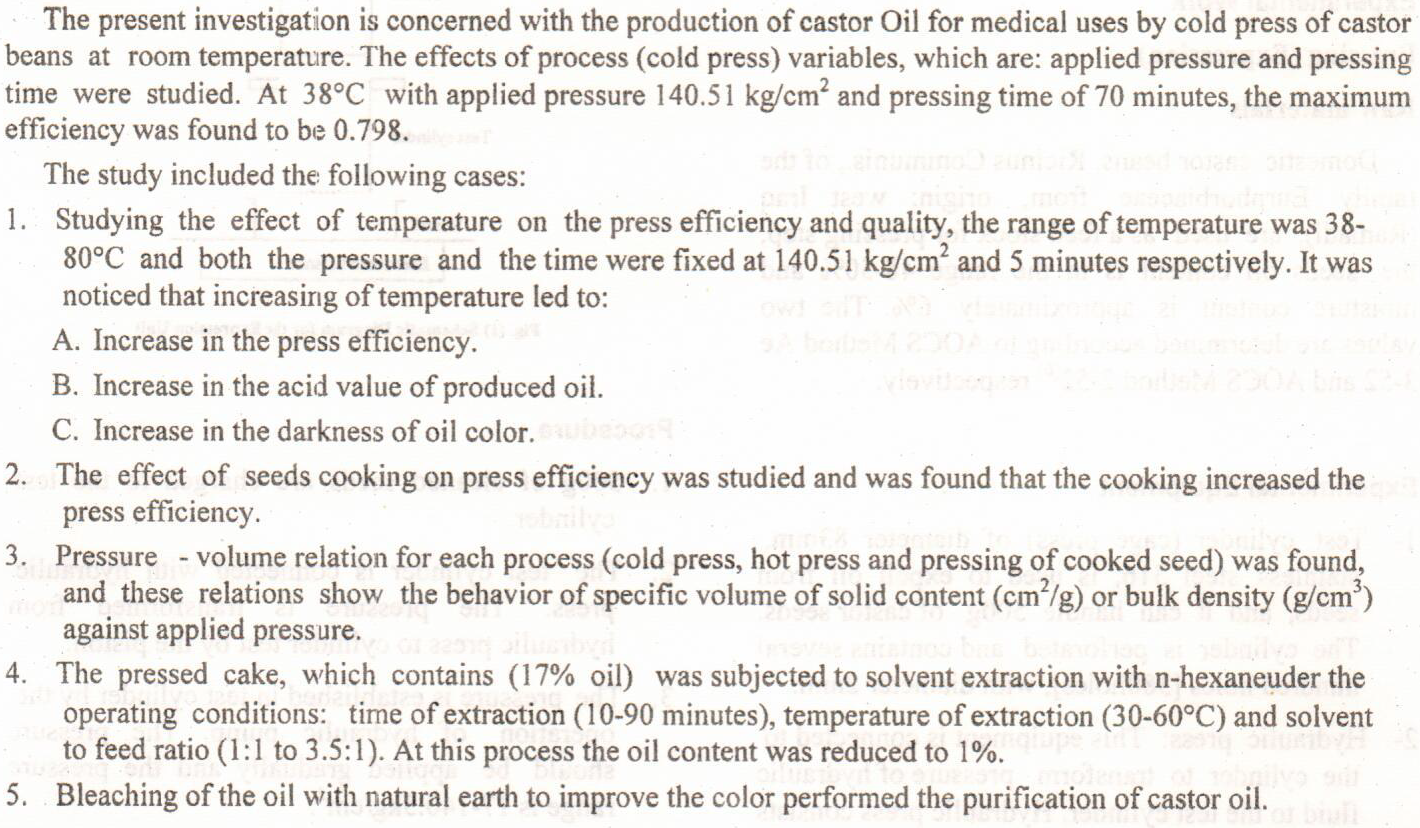
Production of Castor Oil for Medical Uses

Oil from Brassca campestris (local variety) was extracted with hexane using Soxhlet. The extracted oil was characterized and its antimicrobial activity was determined as well. The content of extracted oil was 40% with 0.5% of volatile oil .Oil was immiscible with polar solvent such as ethanol, acetone and water, while it was easily miscible with chloroform due to its hydrophobicity. The result of organoleptic tests revealed that the oil is clear yellow in color and odorless with acceptable taste. The oil was stable at 4 -25 C? for a month. Refractive index (RI) of oil was 1.4723 with density of 0.914, [both at 4-25 C?]. Boiling point 386 C?. Infra red spectroscopy (IR) indicated the presence of different chemical groups (C=C
... Show More
Naturally occurring radioactive materials (NORM) contaminated sites at Al-Rumaila Iraqi oil fields have been characterized as a part of soil remediation project. Activity of radium isotopes in contaminated soil have been determined using gamma spectrometer High Purity Germanium detector (HPGe) and found to be very high for Al-Markezia, Al-Qurainat degassing stations and storage area at Khadhir Almay region. The activity concentration of samples ranges from 6474.11±563.8 Bq/kg to 1232.5±60.9 Bq/kg with mean value of 3853.3 Bq/kg for 226Ra, 843.59±8.39 Bq/kg to 302.2±9.2 Bq/kg with mean value of 572.9 Bq/kg for 232Th and 294.31±18.56 Bq/kg to 156.64±18.1 Bq/kg with mean value of 225.5 for 40K. S
... Show MoreDiesel engine oil was subjected to thermal oxidization (TO) for six periods of time (0 h, 24 h, 48 h, 72 h, 96 h, and 120 h) and was subsequently characterized by terahertz time domain spectroscopy (THz-TDS). The THz refractive index generally increased with oxidation time. The measurement method illustrated the potential of THz-TDS when a fixed setup with a single cuvette is used. A future miniaturized setup installed in an engine would be an example of a fixed setup. For the refractive index, there were highly significant differences among the oxidation times across most of the 0.3–1.7 THz range.
 (10)
(10)
 (9)
(9)


The Gas Assisted Gravity Drainage (GAGD) process has become one of the most important processes to enhance oil recovery in both secondary and tertiary recovery stages and through immiscible and miscible modes. Its advantages came from the ability to provide gravity-stable oil displacement for improving oil recovery, when compared with conventional gas injection methods such as Continuous Gas Injection (CGI) and Water – Alternative Gas (WAG). Vertical injectors for CO2 gas were placed at the top of the reservoir to form a gas cap which drives the oil towards the horizontal oil producing wells which are located above the oil-water-contact. The GAGD process was developed and tested in vertical wells to increase oil r
... Show More
(6)
Results of the current study demonstratedthat out of eighty-three isolatesof Pseudomonas aeruginosa,only twenty-five isolateswere resistant to five different antibiotics (of different classes) that were consequentlyconsideredmultidrug resistant isolates.These isolates developed variable susceptibility toward Eucalyptuscamaldulensisleavesoil (ECO). GC-MS analysis of ECOrevealed that the aromatic oil eugenol is the major constituent.However, the most frequent MIC was 0.39 µg/ml, while the lowest frequent MIC was 3.125 µg/ml.Moreover, this oil at ½ MIC (0.195µg/ml) increased the gene expression of exoU. Itis concluded from the outcomes of the studythat ECOmay cause severe damagewhen used to treat infections caused by P. aeruginosa.
... Show More
(1)
In this study, oxidative desulfurization of dibenzothiophene (DBT) with H2O2 as an oxidant was studied, whereas the catalyst used was zirconium oxide supported on Activated carbon (AC). Zirconium oxide (ZrO2) was impregnated over prepared activated carbon (AC) and characterized by various techniques such as XRD, FTIR, BET, SEM, and EDX. This composite was used as a heterogeneous catalyst for oxidation desulfurization of simulated oil. The results of this study showed that ZrO2/AC composite exhibited significant catalytic activity and stability, effectively lowering sulfur content under mild conditions. Factors such as reaction temperature (30, 40, 50, 60°C), time (5, 10, 15,20,30,60, 80 100 min), catalyst dose (0.3, 0.5,
... Show More
Drilling with casing (DWC) can be considered as a modern drilling technique in which both of drilling and casing operations done in the same time by using the casing to transfer the hydraulic and mechanical power to the bit instead of traditional drilling string. To overcome oil well control, minimizing the total cost through enhancing drilling efficiency, drilling with casing was proposed as an enabling technology.
Two surface sections (17 1/2 - and 12 1/4- inch) were drilled successfully in Rumaila oil field with casing strings which reached 655m and 1524m measured depths respectively.
By using DWC technique, the total drill/case phase time was reduced up to 20% comparing to conventional
... Show More
Binary mixtures of three heavy oil-stocks had been subjected to density measurments. The data had been aquired on the volumetric behaviour of these systems. The heavy oil-stocks used were of good varity, namely 40 stock , 60 stock, and 150 stock, 40 stock is the lightest one with the API gravity 33.7 while 60 stock is middle type and 150 stock is heavy one, with API gravity 27.7 and 23.8 respectively. Stocks with Kerosene or Xylene for non-ideal mixtures for which excess volume can be positive or negative. Mixture of heavy-oil stocks with paraffinic spike (Kerosene) show negative excess volume. While, aromatic rings results a lower positive excess volume, as shown in Xylene when blending with 40 stock and 60 stock but a negati
... Show MoreSadi formation is one of the main productive formations in some of Iraqi oil fields. This formation is characterized by its low permeability values leading to low production rates that could be obtained by the natural flow.
Thus, Sadi formation in Halfaya oil field has been selected to study the success of both of "Acid fracturing" and "Hydraulic fracturing" treatments to increase the production rate in this reservoir.
In acid fracturing, four different scenarios have been selected to verify the effect of the injected fluid acid type, concentration and their effect on the damage severity along the entire reservoir.
The reservoir damage severity has been taken as "Shallow–Medium– Sever
... Show More