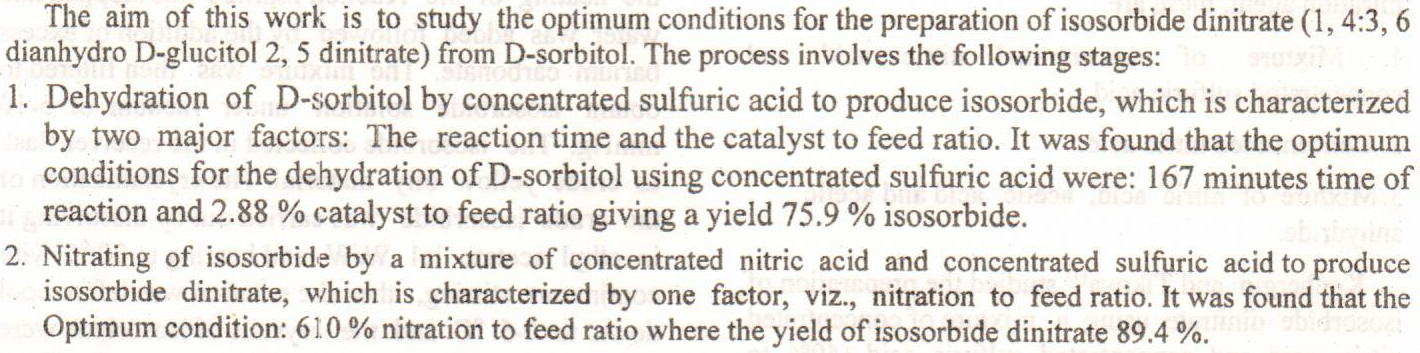
The Preparation of Isosorbide Dinitrate

In this study, NAC-capped CdTe/CdS/ZnS core/double shell QDs were synthesized in an aqueous medium to investigate their utility in distinguishing normal DNA from mutated DNA extracted from biological samples. Following the interaction between the synthesized QDs with DNA extracted from leukemia cases (represents damaged DNA) and that of healthy donors (represents undamaged DNA), differential fluorescent emission maxima and intensities were observed. It was found that damaged DNA from leukemic cells DNA-QDs conjugates at 585 nm while intact DNA (from healthy subjects) DNA–QDs conjugates at 574 nm. The obtained results from the optical analyses indicate that the prepared QDs could be utilized as probe for detecting disrupted DNA th
... Show More (3)
(3)
 (3)
(3)



Mixed ligand metal complexes of CrIII, FeIII,II, NiII and CuII have been synthesized using 5-chlorosalicylic acid (5-CSA) as a primary ligand and L-Valine (L-Val) as secondary ligand. The metal complexes have been characterized by elemental analysis, electrical conductance, magnetic susceptibility measurements and spectral studies. The electrical conductance studies of the complexes indicate their electrolytic nature. Magnetic susceptibility measurements revealed paramagnetic nature of the all complexes. Bonding
Lasmiditan (LAS) is a recently developed antimigraine drug and was approved in October, 2019 for the treatment of acute migraines; however, it suffers from low oral bioavailability, which is around 40%.
This study aimed to improve the LAS bioavailability via formulation as nanoemulsionbased in situ gel (NEIG) given intranasally and then compare the traditional aqueous-LASsuspension (AQS) with the two successful intranasal prepared formulations (NEIG 2 and NEIG 5) in order to determine its relative bioavailability (F-relative) via using rabbits.
(10)
(9)
The goals of endodontic preparation were to shape and clean the space of the root canal and remove microorganisms, affected dentin and pulp, the apical foramen and the canal curve should be protected from being transported during endodontic canal preparation. The aim of this study was to evaluate the curve straightening of curved root canals and apical transportation after preparation with four rotary systems. Forty mesial roots of the lower 1st molars teeth only the mesiobuccal canals were used, these roots were immersed into cold clear acrylic , the teeth roots divided into four groups according to rotary system used for preparation of the canals (ten roots for each group):. group I: ProTaper Next rotary system, group II: IRaCe Plus rotar
... Show MoreIn this work a series of fourteen new compounds were synthesized. Compound [1] was formed from the reaction of 2-aminobenzothiazole and p-bromophenacyl bromide. Aldehyde group [2] was obtained from the reaction of compound [1] with pocl3 in presence of DMF and CHCl3 .After that shiff bases have been synthesized from the reaction of compound [2] with different aromatic amine to give new shiff bases [3- 5]. These new shiff bases have been reduced to their corresponding amine [6-8] by means of sodium borohydride. Then reaction of shiff bases [3-5] with phenyl isocyanate gives 3-cyclic lactam derivatives [9-11]. 3-cyclic Oxazepine derivatives [12-14] were obtained by reaction of shiff bases [3-5] with succinic anhydride. These new formed co
... Show Morefication of benzaldehyde (C6H5CHO) and O- amino aniline O-C6H4(NH2)2 in ethanol with 8- Hydroxyquinoline (8HQ) . Formed compounds were acquired of 1:1:2 molar proportion reactions for metal ions and ligands (L) and 2(8HQ) during reaction for MCl2 .nH2O salt products complexes conformable into the forms [M(L)(8HQ)2] ,where M = Mn(II),Co(II) and Ni(II). Whole the compounds were identified during the basis of their; FT-IR and U.V spectrum, melting point, molar conduct, identify of the percentage from the metal at the complexes via flame (AAS), C, H and N content of the Schiff base (L) and metal complexes were analysis and magnetic susceptibility menstruations. A hexagonal coordinated metal complexes were proposed to the separated complexes of
... Show MoreThe ligand 2-[1-(1H-indol-3-yl)ethylimino) methyl]naphthalene-1-ol, derived from 1-hydroxy-2-naphthaldehyde and 2-(1H-indol-3-yl)ethylamine, was used to produce a new sequence of metal ions complexes. Thus ligand reactions with NiCl2.6H2O, PdCl2, FeCl3.6H2O and H2PtCl6.6H2O were sequentially made to collect mono-nuclear Ni(II), Pd(II), Fe (III), and Pt(IV). (IR or FTIR), Ultraviolet Reflective (UV–visible), Mass Spectra analysis, Bohr-magnetic (B.M.), metal content, chloride content and molar conductivity have been the defining features of the composites. The Fe(III) and Pt(IV) complexes have octahedral geometries, while the Ni(II) complex has tetra
... Show More
(16)
(5)
This search includes the preparation of Schiff base ligand (SB) from condensation primary amine with vanillin. The new ligand was diagnosed by spectroscopic methods as Mass, NMR, CHN and FTIR. Ligand complexes were mixed from new (SB) and Anthranillic acid (A) with five metal (II) chlorides. The preparation and diagnosis were conducted by FTIR, CHN, UV-visible, molar conductivity, atomic absorption and magnetic moment. The octahedral geometrical shape of the complexes was proposed. The ligands and their new complexes were screened with two different types of bacteria.
(22)
(3)
Five new lanthanide complexes based on azomethine (Schiff bases) ligands have been synthesized, including La, Nd, Er, Gd, and Dy. Complexes were synthesized using the azomethine Schiff bases resulting from condensation reactions between 4-aminoantipyrine and acetonylacetone. The structural characteristics of azomethine obtained are characterized quantitatively and qualitatively through various techniques, including elemental analyses, magnetic susceptibility measurement, molar conductivity, infrared, ultraviolet absorption, GC-mass, and 1H- and 13C-NMR spectroscopy studies. The structural characteristics of Ln+3 complexes indicate that the complexes possess a composition of a specific type. Based on the elemental analyses, magnetic
... Show More
(1)
(2)
A new ligand complexes have been synthesis from reaction of metal ions of Mn(II), Co(II), Ni(II), Cu(II), Zn(II), Cd(II), Hg(II), Pd(II) and Pt(II) with schiff base LH. 5-[(2-Hydroxy-naphthalen-1-ylmethylene)-amino]-2-phenyl-2,4-dihydro-pyrazol-3-one, this ligand was characterized by Fourier transform infrared (FTIR), UV-vis, 1H, 13CNMR, and mass spectra. All complexes were characterized by techniques micro analysis C.H.N, UV-vis and FTIR spectral studies, atomic absorption, chloride content, molar conductivity measurements and magnetic susceptibility. The ligand acts as bidentate, coordination through nitrogen atom from azomethin group and deprotonated phenolic oxygen atom. The spectroscopic and analytical measurements showed that
... Show More