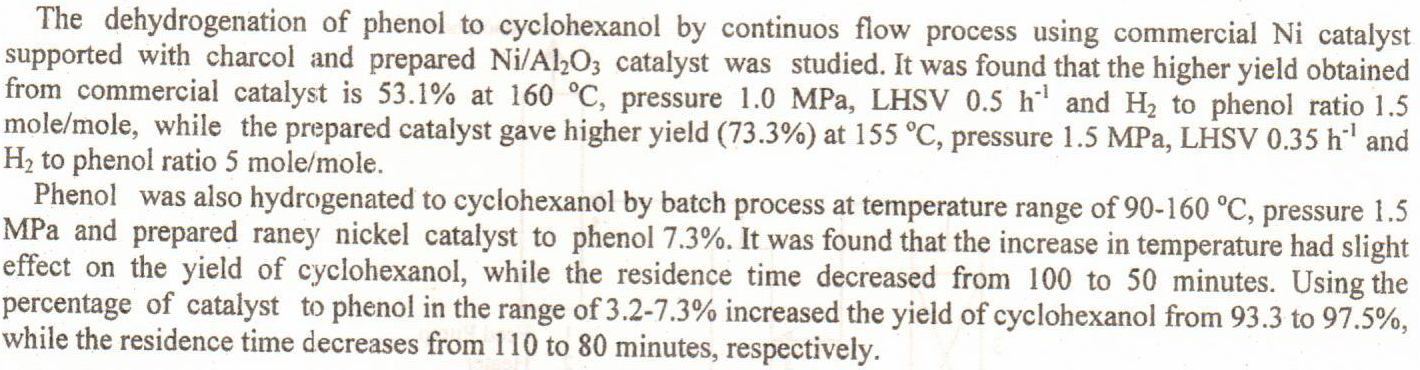
Batch and Continuous Process of Cyclohexanol Production

There is a continuous and massive need for newer cephalosporins that should have resistance against β-lactamases and can be used orally. An approach of using cephalexin, as a well-studied and potent antibacterial compound is considered to prepare new designed derivatives. These derivatives include the incorporation of amino acid moiety linked through an amide bond with the α-amino group of cephalexin. Certain aliphatic amino acids were used, such as glycine, alanine, valine and proline. The chemical structures of these derivatives were confirmed by IR spectroscopy and elemental analyses. All the synthesized compounds were subjected for preliminary evaluation of antimicrobial activity using well diffusion method, against certa
... Show More (1)
(1)

Multi-nationalities companies are the main companies in the progressed
countries that improve the current technology and, thus, become the main source of it.
These companies, in the first place, aim to increase the profits of its
investments to satisfy stock holders in the original countries to which these companies
belong.
It is a mean to interfere in the economic of countries especially the growing
ones and exploit their important natural resources. Since this research focus on the
dangers of these companies, mechanism of its work and its dangers on the most
important natural resources of our country which is oil; therefore, the research
confirm that this important natural treasure must be under an Iraqi cont
 (1)
(1)

In this work ester derivatives were synthesized by the reaction of imidazole derivatives (C1) with ethylchloroacetate in ethanol and NaOH to give the corresponding (C2) .While compound (C3) acetohydrazide was synthesized by the reaction of ester derivatives (C2) with hydrazine hydrat in ethanol. Compound (C3) from the reaction with different aromatic aldehydes in absolute ethanol gave the Schiff′s bases (C4,C5). The product compounds were characterized by FT-IR, U.V and 1HNMR spectra and the biological activities were studied as antibacterial.
In the present study, a pressure drop technique was used to identify the phase inversion point of oil-in-water to water-in-oil flows through a horizontal pipe and to study the effect of additives (nanoparticles, cationic surfactant and blend nanoparticles-surfactant) on the critical dispersed volume fraction (phase inversion point). The measurements were carried for mixture velocity ranges from 0.8 m/sec to 2.3 m/sec. The results showed that at low mixture velocity 0.8 and 1 m/sec there is no effect of additives and velocity on phase inversion point, while at high mixture velocities the phase inversion point for nanoparticles and blend (nanoparticles/surfactant) systems was delayed (postponed) to a higher value of the dispers
... Show MoreI've been in this work to prepare some complexes containing mixed Kandat with some transitional elements which new complexes according to the best of our knowledge and to refer to the information from the Internet until I have been studying this diagnosis Aalmakdat
KE Sharquie, AA Noaimi, SY Mohsin, 2011 - Cited by 4
We have investigated the photoemission and electronic properties at the PTCDI molecules interface on TiO2 and ZnO semiconductor by means of charge transition. A simple donor acceptor scenario used to calculate the rate for electron transfer of delocalized electronics in a non-degenerately TiO2 and ZnO electrodes to redox localized acceptors in an electrolytic. The dependent of electronic transition rate on the potential at contact of PTCDI with TiO2 and ZnO semiconductors, it has been discussion using TiO2 and ZnO electrodes in aqueous solutions. The charge transfer rate is determining by the overlapping electronic coupling to the TiO2 and ZnO electrodes, the transition energy, potential and polarity media within the theoretical scenario of
... Show More
(7)
Field experiment was conducted during 2007 in the experimental field of crop science Department/ Collage of Agriculture/ University of Baghdad, in order to identify the mechanism of compensation of cotton plant of Lashata Variety, with different levels of fruiting form removal in various time intervals and the effect of this factor on yield component. We use complete randomized block design with three replications. To compare the treatments: (control), 50% bud removal for one, two and three successive weeks, and 100% bud removal for one, two and three successive weeks, 50% flower removal for one, two and three successive weeks and 100% flower removal for one, two and three successive weeks, 50% boll removal for one, two and three successive
... Show More
(19)