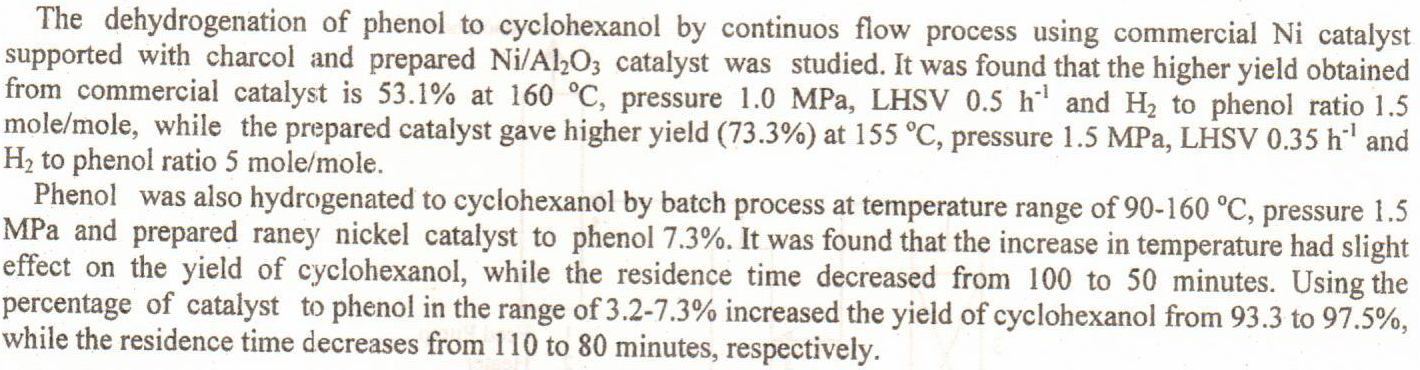
Batch and Continuous Process of Cyclohexanol Production

In this work, production of silicon metal at high purity of 99% by using Iraqi–starting materials (Iraqi sand and plant coal)was reported, electric arc–furnaces assembly was manufactured inside, the graphite electrodes were made from graphite scrap, this system is operate to produce about 800 gm /6hr of silicon metal to meet the need for manufacturing silicon oils, resins, solar cells, and electronic parts. The procedure, equipments and analysis data were described as well.

The intensification of competition among all companies and at different levels has become necessary for every company need to continue to improve its performance in order to be able to face the competition and stay in the market. To achieve this, we must rely on the company's accounting information more accurate and appropriate and provided in a timely manner, for the purpose of use in planning and decision making.
So there must be information systems that help the administration to continuous development and improvement of the performance of companies in general, and this is what you need Jordanian companies, especially after the accession of Jordan to the field
... Show More
Bioethanol produced from lignocellulose feedstock is a renewable substitute to declining fossil fuels. Pretreatment using ultrasound assisted alkaline was investigated to enhance the enzyme digestibility of waste paper. The pretreatment was conducted over a wide range of conditions including waste paper concentrations of 1-5%, reaction time of 10-30 min and temperatures of 30-70°C. The optimum conditions were 4 % substrate loading with 25 min treatment time at 60°C where maximum reducing sugar obtained was 1.89 g/L. Hydrolysis process was conducted with a crude cellulolytic enzymes produced by Cellulomonas uda (PTCC 1259).The maximum amount of sugar released and hydrolysis efficiency were 20.92 g/L and 78.4 %, respectively. Sugars
... Show More (1)
(1)
Geographic information system (GIS) is utilized in a variety of tasks such as, resource management, urban planning, emergency planning in case of accident, and rapid response etc. The aim of this study is to produce a digital map with the aid of GIS and a survey data. A survey data is conducted with Total Station technique on sanitary planning positions. The campus of Baghdad University is chosen to test the execution and accuracy of the results for sewer manholes locations. During the field survey, Total Station (Nikon Nivo) is used to identify the 3-D coordinates for each location. Finally, Geographical Information System (GIS) are utilized to present the digital map of the network sewer pipe line to the end users. Although Geographic Inf
... Show MoreMolasse medium containing different concentrations of (NH4)2 SO4, (NH4)3 PO4, urea, KCI, and P2O5 were compared with the medium used for commercial production of C. utilis in a factory south of Iraq. An efficient medium, which produced 19. 16% dry wt. and 5. 78% protein, was developed. The effect of adding various concentrations of micronutrients (FeSO4, 7T20, MnSO4. 7H20, ZnSO4. 7E20) was also studied. Results showed that FeSo4. 7H20 caused a noticeable increase in both dry wt. and protein content of the yeast.
Refuse derived fuel (RDF) is considered one of the most important types of low cost thermal energy which can be tapped in the industry, especially the cement industry in particular being the need of high thermal energy during the production processes, and in this paper we have implemented the use of a derivative of the fuel RDF as a substitute for gasoline , to reduce production costs and thereby achieve production efficiency, and the methodology used in this research statistical analysis as well as the use of the cost of kaizen target for the purpose of reducing costs and achieve production efficiency, and this has reduced the cost total cement production by which led to reduce total costs of cement production by 8.4% and an incre
... Show More
 (15)
(6)
(15)
(6)



