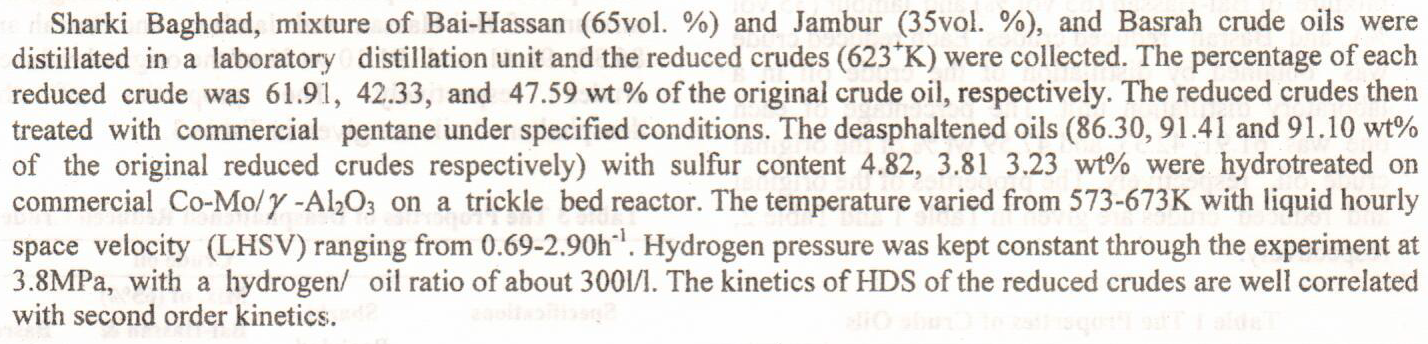
Production of Low Sulfur Fuel Oil from Different Iraqi Residues Crudes

During a survey on the helminthic parasites of three species of turtles in the north part of Iraq, five species of nematodes were recorded for the first time in Iraq. They were all found in the intestine. These are, Camallanus microcephalus (Dujardin, 1845) recorvered from the turtle Clemmys caspica; Spironoura japonensis (Yamaguti, 1935) from Triopyx eup¬hraticus and Angusticaecum holopterum (Rudolphi, 1819), and Tachygonetria nicollei (Seurat, 1918) from the turtle Testudo graeca. All of the localities and hosts are newly recorded in Iraq.
Oil flow lines are used to transport oil and its derivatives from a well over long distances, and because oil wells produce other potentially corrosive products, such as carbon dioxide and Hydrogen sulfide, it is necessary to take methods to protect the pipeline from corrosion. One of these methods is the use of corrosion inhibitors in this study. Prepare 5-acetyl-2-anilino-4-dimethylaminothiazole and test it as a corrosion inhibitor on a sample of the Rumaila flow line at a constant temperature 25°C in (3.5%) NaCl and (3.5%) KCl solution in the absence and presence of different concentrations of inhibitor (0 mM, 0.01 mM, 0.03 M, 0.05 mM). by using liner polarization (Tafel slope). The inhibiter exhibited the best performance at hi
... Show More (2)
(2)
 (6)
(6)
The analysis of Iraqi light oil (light naphtha) by capillary gas chromatography- mass spectrometry (GC-MS) was performed by the injection of whole naphtha sample without use of solvents. Qualitative analysis and the identification of the hydrocarbon constituents of light naphtha was performed and comparison had been done with American light oil (light naphtha). The obtained results showed a major difference between the two-light naphtha.
Exploitation of mature oil fields around the world has forced researchers to develop new ways to optimize reservoir performance from such reservoirs. To achieve that, drilling horizontal wells is an effective method. The effectiveness of this kind of wells is to increase oil withdrawal. The objective of this study is to optimize the location, design, and completion of a new horizontal well as an oil producer to improve oil recovery in a real field located in Iraq. “A” is an oil and gas condensate field located in the Northeast of Iraq. From field production history, it is realized the difficulty to control gas and water production in this kind of complex carbonate reservoir with vertical producer wells. In this study, a horizont
... Show More (4)
(3)
(4)
(3)
 (13)
(12)
(13)
(12)

It is very difficult to obtain the value of a rock strength along the wellbore. The value of Rock strength utilizing to perform different analysis, for example, preventing failure of the wellbore, deciding a completion design and, control the production of sand. In this study, utilizing sonic log data from (Bu-50) and (BU-47) wells at Buzurgan oil field. Five formations have been studied (Mishrif, Sadia, Middle lower Kirkuk, Upper Kirkuk, and Jaddala) Firstly, calculated unconfined compressive strength (UCS) for each formation, using a sonic log method. Then, the derived confined compressive rock strengthens from (UCS) by entering the effect of bore and hydrostatic pressure for each formation. Evaluations th
... Show More
(3)
Compassion competence is a nurse's ability to provide patient-centered care and communicate with patients in a sensitive and insightful manner. This descriptive cross-sectional survey study aimed to assess the compassion competence of a multinational group of nursing students.
A total of 1,158 undergraduate nursing students participated in this study, and stratified random sampling method was used to select participants from the 100 study level to the 400 or 500 level. Data were collected using the Compassion Competence Scale.
<
(14)
(17)
Background: Pumpkin seeds are a valuable source of high-quality protein and can be utilized as functional food ingredients due to their properties, such as solubility, foam formation, and stability. This study aims to produce protein isolate and its enzymatic hydrolysates from local pumpkin seeds to study their properties. Methodology: Preparing defatted pumpkin seeds for protein extraction, followed by the enzymes’ hydrolysis using Trypsin and Pepsin enzymes separately and together in two methods. The determination of amino acids and the degree of hydrolysis was conducted; moreover, protein properties were studied, including solubility, emulsifying activity, stability index, foaming capacity, and stability. Results: A protein sample was
... Show More