Production of Low Sulfur Fuel Oil from Different Iraqi Residues Crudes
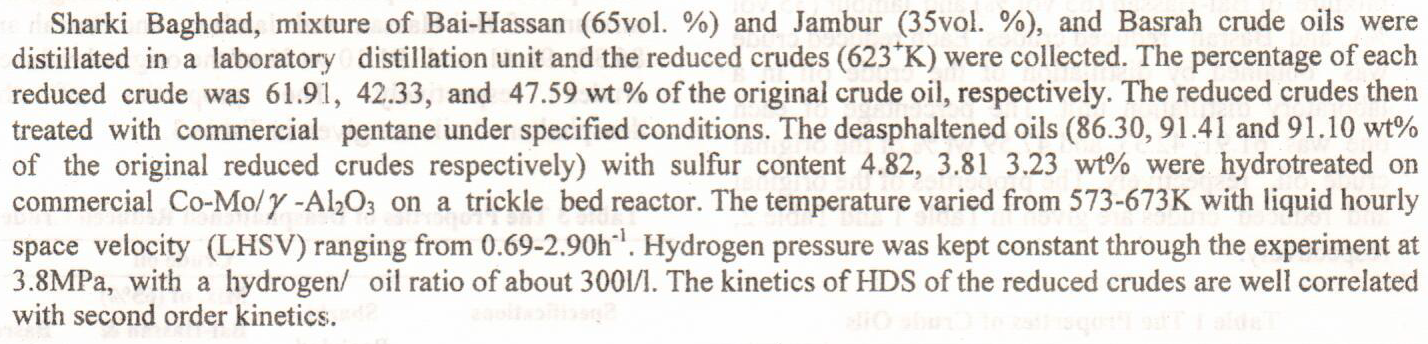

The petroleum sector has a significant influence on the development of multiphase detection sensor techniques; to separate the crude oil from water, the crude oil tank is used. In this paper, a measuring system using a simple and low cost two parallel plate capacitance sensor is designed and implemented based on a Micro controlled embedded system plus PC to automatically identify the (gas/oil) and (oil/water) dynamic multi-interface in the crude oil tank. The Permittivity differences of two-phase liquids are used to determine the interface of them by measuring the relative changes of the sensor’s capacitance when passes through the liquid’s interface. The experiment results to determine the liquid’s interface is sa
... Show More
A new application of a combined solvent extraction and two-phase biodegradation processes using two-liquid phase partitioning bioreactor (TLPPB) technique was proposed and developed to enhance the cleanup of high concentration of crude oil from aqueous phase using acclimated mixed culture in an anaerobic environment. Silicone oil was used as the organic extractive phase for being a water-immiscible, biocompatible and non-biodegradable. Acclimation, cell growth of mixed cultures, and biodegradation of crude oil in aqueous samples were experimentally studied at 30±2ºC. Anaerobic biodegradation of crude oil was examined at four different initial concentrations of crude oil including 500, 1000, 2000, and 5000 mg/L. Complete removal of crud
... Show More
In this research, the effect of reinforcing epoxy resin composites with a filler derived from chopped agriculture waste from oil palm (OP). Epoxy/OP composites were formed by dispersing (1, 3, 5, and 10 wt%) OP filler using a high-speed mechanical stirrer utilizing a hand lay-up method. The effect of adding zinc oxide (ZnO) nanoparticles, with an average size of 10-30 nm, with different wt% (1,2,3, and 5wt%) to the epoxy/oil palm composite, on the behavior of an epoxy/oil palm composite was studied with different ratios (1,2,3, and 5wt%) and an average size of 10-30 nm. Fourier Transform Infrared (FTIR) spectrometry and mechanical properties (tensile, impact, hardness, and wear rate) were used to examine the composites. The FTIR
... Show More (7)
(7)
Geologic modeling is the art of constructing a structural and stratigraphic model of a reservoir from analyses and interpretations of seismic data, log data, core data, etc. [1].
A static reservoir model typically involves four main stages, these stages are Structural modeling, Stratigraphic modeling, Lithological modeling and Petrophysical modeling [2].
Ismail field is exploration structure, located in the north Iraq, about 55 km north-west of Kirkuk city, to the north-west of the Bai Hassan field, the distance between the Bai Hassan field and Ismael field is about one kilometer [3].
Tertiary period reservoir sequences (Main Limestone), which comprise many economica
... Show MoreOil from Brassca campestris (local variety) was extracted with hexane using Soxhlet. The extracted oil was characterized and its antimicrobial activity was determined as well. The content of extracted oil was 40% with 0.5% of volatile oil .Oil was immiscible with polar solvent such as ethanol, acetone and water, while it was easily miscible with chloroform due to its hydrophobicity. The result of organoleptic tests revealed that the oil is clear yellow in color and odorless with acceptable taste. The oil was stable at 4 -25 C? for a month. Refractive index (RI) of oil was 1.4723 with density of 0.914, [both at 4-25 C?]. Boiling point 386 C?. Infra red spectroscopy (IR) indicated the presence of different chemical groups (C=C
... Show More
Binary mixtures of three heavy oil-stocks had been subjected to density measurments. The data had been aquired on the volumetric behaviour of these systems. The heavy oil-stocks used were of good varity, namely 40 stock , 60 stock, and 150 stock, 40 stock is the lightest one with the API gravity 33.7 while 60 stock is middle type and 150 stock is heavy one, with API gravity 27.7 and 23.8 respectively. Stocks with Kerosene or Xylene for non-ideal mixtures for which excess volume can be positive or negative. Mixture of heavy-oil stocks with paraffinic spike (Kerosene) show negative excess volume. While, aromatic rings results a lower positive excess volume, as shown in Xylene when blending with 40 stock and 60 stock but a negati
... Show MoreIMPLICATION OF GEOMECHANICAL EVALUATION ON TIGHT RESERVOIR DEVELOPMENT / SADI RESERVOIR HALFAYA OIL FIELD

In this research, the effect of reinforcing epoxy resin composites with a filler derived from chopped agriculture waste from oil palm (OP). Epoxy/OP composites were formed by dispersing (1, 3, 5, and 10 wt%) OP filler using a high-speed mechanical stirrer utilizing a hand lay-up method. The effect of adding zinc oxide (ZnO) nanoparticles, with an average size of 10-30 nm, with different wt% (1,2,3, and 5wt%) to the epoxy/oil palm composite, on the behavior of an epoxy/oil palm composite was studied with different ratios (1,2,3, and 5wt%) and an average size of 10-30 nm. Fourier Transform Infrared (FTIR) spectrometry and mechanical properties (tensile, impact, hardness, and wear rate) were used to examine the composites. The
... Show More
(7)
The Gas Assisted Gravity Drainage (GAGD) process has become one of the most important processes to enhance oil recovery in both secondary and tertiary recovery stages and through immiscible and miscible modes. Its advantages came from the ability to provide gravity-stable oil displacement for improving oil recovery, when compared with conventional gas injection methods such as Continuous Gas Injection (CGI) and Water – Alternative Gas (WAG). Vertical injectors for CO2 gas were placed at the top of the reservoir to form a gas cap which drives the oil towards the horizontal oil producing wells which are located above the oil-water-contact. The GAGD process was developed and tested in vertical wells to increase oil r
... Show More
(8)