Preferred Language
Articles
/
bijps-1443
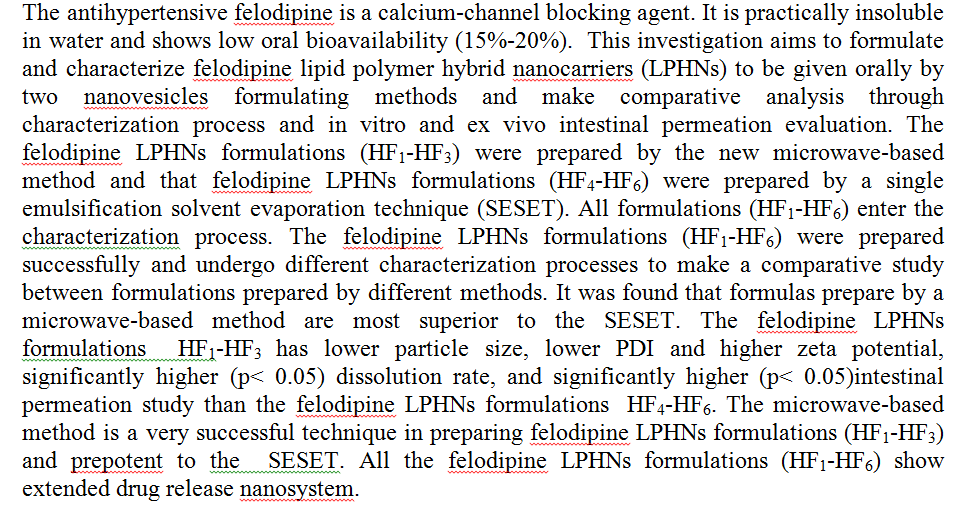
Investigation of Lipid Polymer Hybrid Nanocarriers for Oral Felodipine Delivery: Formulation, Method, In-vitro and Ex-vivo Evaluation
...Show More Authors

Scopus Crossref
View Publication Preview PDF
Quick Preview PDF
Publication Date
Thu Jan 08 2015
Journal Name
Chemical And Process Engineering Research
Uni and Simplex Optimization for the Spectrophotometric Determination of Erythromycin ethylsuccinate Drug via Charge-Transfer Complex Formation
...Show More Authors

Charge transfer complex formation method has been applied for the spectrophotometric determination of erythromycin ethylsuccinate, in bulk sample and dosage form. The method was accurate, simple, rapid, inexpensive and sensitive depending on the formed charge- transfer complex between cited drug and, 2,3- Dichloro-5,6-dicyano-p- benzoquinone (DDQ) as a chromogenic reagent. The formed complex shows absorbance maxima at 587 nm against reagent blank. The calibration graph is linear in the ranges of (10 - 110) μg.mL-1 with detection limit of 0.351μg.mL-1. The results show the absence of interferences from the excipients on the determination of the drug. Therefore the proposed method has been successfully applied for the determination of eryth

... Show More
Preview PDF
Publication Date
Wed Nov 02 2016
Journal Name
Ibn Al-haitham Jour. For Pure & Appl. Sci.
Synthesis, Spectroscopic and Adsorption Studies of Cobalt (II) Complex for a ligand β-enaminone Derived from Sulfamethoxazole
...Show More Authors

This paper concerns is the preparation and characterization of a bidentate ligand [4-(5,5- dimethyl-3-oxocyclohex-1-enylamino)-N-(5-methylisoxazol-3-yl) benzene sulfonamide]. The ligand was prepared from fusing of sulfamethoxazole and dimedone at (140) ºC for half hour. The complex was prepared by refluxing the ligand with a bivalent cobalt ion using ethanol as a solvent. The prepared ligand and complex were identified using Spectroscopic methods. The proposed tetrahedral geometry around the metal ions studied were concluded from these measurements. Both molar ratio and continuous variation method were studied to determine metal to ligand ratio (M:L). The M to L ratio was found to be (1:1). The adsorption of cobalt complex was carried out

... Show More
Publication Date
Tue Jul 17 2018
Journal Name
Journal Of Global Pharma Technology
Preparation, Characterization and Biological Activity Studies of Some Metal Complexes with New Schiff Base for Trimethoprim Ligand
...Show More Authors

A new ligand complexes have been synthesis from reaction of metal ions of MnII , CoII , NiII , CuII , ZnII , CdII and PdII with schiff base [(E)-1-((2-amino-5-(3, 4, 5-trimethoxybenzyl) pyrimidin-4-ylimino) methyl) naphthalen-2-ol [HL)]. The prepared [HL] was characterized by FT-IR, UV-Vis spectroscopy, 1H13CNMR spectra Mass spectra and melting point. The compounds were characterized by techniques UV-Vis and FT-IR spectral studies, micro analysis (C.H.N), determination of atomic absorption, chloride content, molar conductivity measurements, magnetic susceptibility and melting point. The ligand acts as a monobasic tridentate, coordinating through deprotonated phenolic O and azomethine N atoms. The compounds are neutral electrolytic in dimeth

... Show More
Publication Date
Tue Oct 24 2023
Journal Name
Environmental Engineering Research
Exploring electromembrane extraction and liquid membrane for efficient removal of heavy metals from aqueous solutions: An overview
...Show More Authors

Environmental pollution is experiencing an alarming surge within the global ecosystem, warranting urgent attention. Among the significant challenges that demand immediate resolution, effective treatment of industrial pollutants stands out prominently, which for decades has been the focus of most researchers for sustainable industrial development aiming to remove those pollutants and recover some of them. The liquid membrane (LM) method, specifically electromembrane extraction (EME), offers promise. EME deploys an electric field, reducing extraction time and energy use while staying eco-friendly. However, there's a crucial knowledge gap. Despite strides in understanding and applying EME, optimizing it for diverse industrial pollutant

... Show More
View Publication
Scopus (3)
Crossref (3)
Scopus Clarivate Crossref
Publication Date
Mon Jun 01 2020
Journal Name
Journal Of Engineering
Reliability Analysis of Multibit Error Correcting Coding and Comparison to Hamming Product Code for On-Chip Interconnect
...Show More Authors

Error control schemes became a necessity in network-on-chip (NoC) to improve reliability as the on-chip interconnect errors increase with the continuous shrinking of geometry. Accordingly, many researchers are trying to present multi-bit error correction coding schemes that perform a high error correction capability with the simplest design possible to minimize area and power consumption. A recent work, Multi-bit Error Correcting Coding with Reduced Link Bandwidth (MECCRLB), showed a huge reduction in area and power consumption compared to a well-known scheme, namely, Hamming product code (HPC) with Type-II HARQ. Moreover, the authors showed that the proposed scheme can correct 11 random errors which is considered a high

... Show More
View Publication Preview PDF
Crossref
Publication Date
Wed Mar 10 2021
Journal Name
Baghdad Science Journal
Improving the Performance of Constructed Wetland Microbial Fuel Cell (CW- MFC) for Wastewater Treatment and Electricity Generation
...Show More Authors

The current study deals with the performance of constructed wetland (CW) incorporating a microbial fuel cell (MFC) for wastewater treatment and electricity generation. The whole unit is referred to as CW-MFC. This technique involves two treatments; the first is an aerobic treatment which occurs in the upper layer of the system (cathode section) and the second is anaerobic biological treatment in the lower layer of the system (anode section). Two types of electrode material were tested; stainless steel and graphite. Three configurations for electrodes arrangement CW-MFC were used. In the first unit of CW-MFC, the anode was graphite plate (GPa) and cathode was also graphite plate (GPc), in the second CW-MFC unit, the anode was stainless st

... Show More
View Publication Preview PDF
Scopus (9)
Crossref (8)
Scopus Clarivate Crossref
Publication Date
Mon Apr 20 2020
Journal Name
Neuroquantology
The Role of Water Absorption on Thermal Conductivity and Mechanical Properties for (Recycling HDPE-Coal Ash) Composite
...Show More Authors

View Publication
Scopus (7)
Crossref (1)
Scopus Crossref
Publication Date
Sun Mar 13 2011
Journal Name
Baghdad Science Journal
Using of Rustumiya sewage water for irrigation:1- its effect on some soil properties and corn growth
...Show More Authors

This study is conducted to investigate the validity of using different levels of Rustumiya sewage water for irrigation and their effects on corn growth and some of the chemical properties of the soil such as electrical conductivity and soil pH in extract soil paste , the micro nutrient content in soil and plant which are ( Fe , Mn , Zn , Cu , Cd , Pb ). Three levels of sewage water ( 0 , 50 , 100 )% in two stages were used ,the three levels of wastewater ( without soil fertilization ) were used in the first stage , Where 80 Kg N /D+50Kg P2O5 /D was added to the soil as fertilizer in the control (0%) treatment and 40 Kg N/D+25Kg P2O5/D were added to 50 and 100% levels in the second stage .Corn seeds were planted in 12kg plastic pots in Com

... Show More
View Publication Preview PDF
Crossref
Publication Date
Wed Jan 01 2025
Journal Name
Iraqi Journal Of Applied Physics
Structural and Morphological Characteristics of PEKK-Coated Titanium Disks by RF Magnetron Sputtering for Implant Osteointegration Application
...Show More Authors

Pure grade II titanium disks were coated with a thin coating of polyetherketoneketone (PEKK) polymer by RF magnetron sputtering using either nitrogen or argon gas. Sputtering technique was employed at 50 W for one hour at 60°C with continuous flow of nitrogen or argon gas. Field-emission scanning electron microscopy (FE-SEM) showed a continuous, homogeneous, rough PEKK surface coating without cracks. In addition, cross-sectional FE-SEM revealed an average coat thickness of 1.86 μm with argon gas and 1.96 μm with nitrogen gas. There was homogenous adhesion between the coating layer and substrate. The elemental analysis of titanium substrate revealed the presence of carbon, titanium, and oxygen. The RF magnetron sputtering with argon or ni

... Show More
Preview PDF
Publication Date
Wed Jun 01 2022
Journal Name
Iranian Journal Of Chemistry And Chemical Engineering
The Thermal Pre-processing Technique of the Bio-waste for Contaminated Water Treatment: Histological and Experimental Study
...Show More Authors

The current study suggested a thermal treatment as a necessary proactive step in improving the adsorption capacity of bio-waste for contaminants removal in wastewater. This approach was based on the experimental and histological investigation of biowaste pods shell. This investigation showed that these shells compose of parenchyma cells that store secondary metabolites compounds produced from cells were exhibited in present study. The results also reported that these compounds are extracted directly from the cells as soon as they are exposed to an aqueous solution, hampering their use as an adsorbent material. The increase in the weight of bio-waste adsorbent at unit liquid volume increases the production of secondary metabolites compounds

... Show More
View Publication